Executive Summary: The Price of Building the Future First
Brazil did something remarkable. With Pix, its central-bank-run instant-payment system, it gave a continent-sized population free, real-time money transfers that work 24 hours a day — leapfrogging cards, cheques, and slow bank transfers in a single bound. The world studies Pix as a model. So does organized crime.
The same qualities that make Pix brilliant — instant settlement, universal reach, irreversibility — make it the perfect getaway vehicle for fraud. Pix-specific fraud losses reached an estimated R$6.5 billion in 2025, and a reported 28 million Pix-related fraud cases were registered in just the first nine months of the year. Broader online-scam losses topped R$25 billion (about US$5 billion), up more than 25% year on year. A widely cited survey from the Global Anti-Scam Alliance estimated Brazilians lost as much as US$54 billion to scams over the past year, with Brazilians facing an extraordinary 252 scam encounters per person annually.
This is the Pix paradox: a payment system so fast and final that a single moment of misplaced trust becomes an instant, unrecoverable loss.
”Mão Fantasma”: When the Bank Robs Itself Through Your Phone
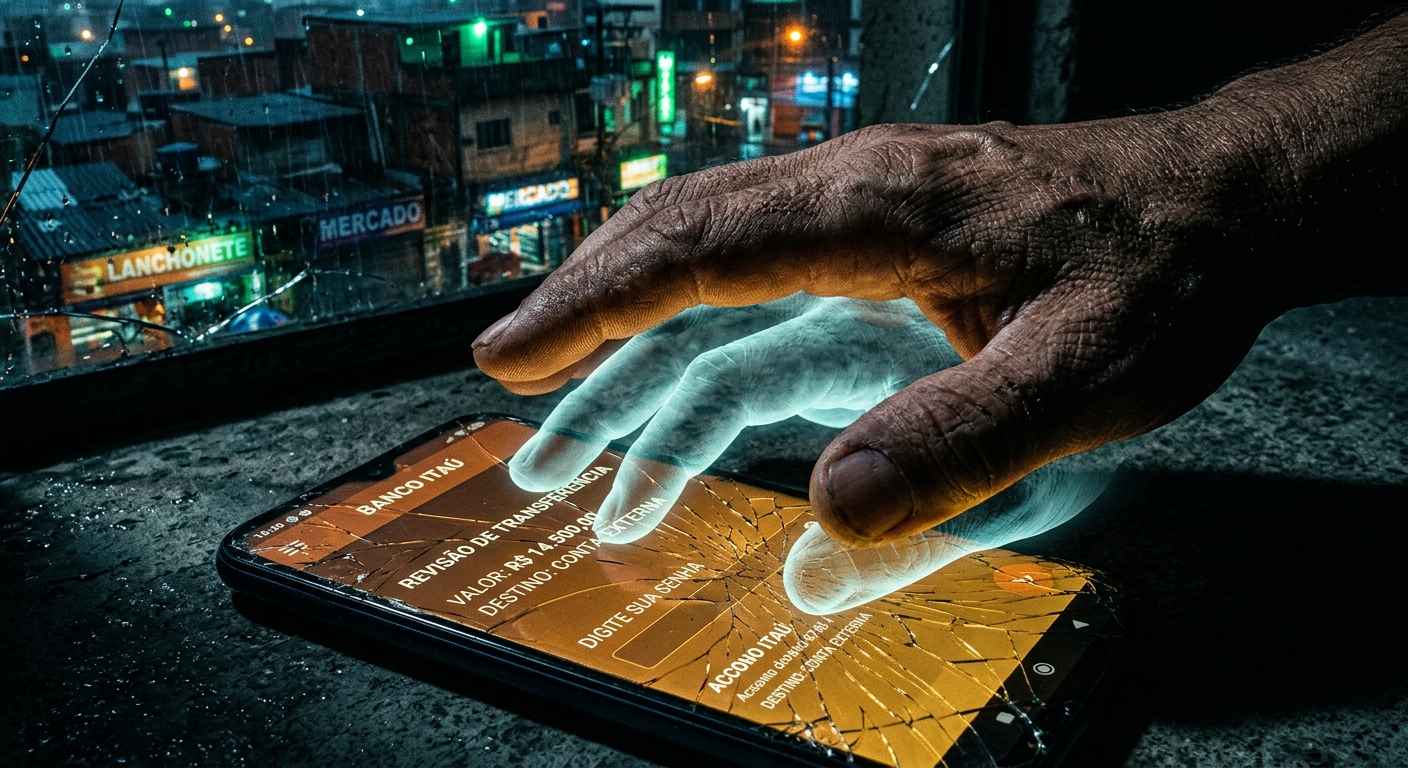
The scam that best captures Brazil’s malware sophistication is the “mão fantasma” — the phantom hand. A scammer posing as bank security convinces the victim to install a “protection” app — actually a legitimate remote-access tool like AnyDesk or TeamViewer. Once connected, the criminal takes control of the victim’s own phone and drains the account via Pix, from the trusted device, while the victim watches helplessly or is kept distracted on the phone.
The banking federation Febraban reported phantom-hand cases up 45% in 2024, and the broader malware picture is worse: security firm BioCatch found malware-driven bank fraud rose 220% in the first half of 2025 versus all of 2024. Banking trojans now spread through WhatsApp worms and NFC-relay tricks, turning Brazil into a global testing ground for mobile financial malware.
Cloned Friends and Fake Tax Men: The WhatsApp Front
If malware is the high-tech end, WhatsApp impersonation is the volume business. Brazil is one of the most WhatsApp-dependent countries on earth, and fraudsters exploit it relentlessly. The classic “golpe do WhatsApp” clones an account or profile photo and messages the victim’s contacts posing as a relative in trouble or a company’s support line — Febraban has tied hundreds of thousands of banking customers to these schemes.
In 2026, the seasonal twist has been fake “Receita Federal” and “Gov.br” messages during income-tax season, threatening to block victims’ CPF (tax ID) unless they click through to a credential-harvesting site. The numbers are dizzying: Serasa Experian recorded more than 180 scam messages per minute on social media in Brazil, and one study found roughly 14 fake websites created every hour, purpose-built for financial fraud.
The Ponzi Capital and the Cartel That Banks Online
Brazil is also a global epicenter for investment and crypto Ponzi schemes, on a scale few countries match. The Braiscompany scheme took R$1.11 billion (about US$190 million) from roughly 20,000 investors; its leaders were sentenced to a combined 171 years in April 2025. The “Bitcoin Pharaoh,” Glaidson Acácio dos Santos, moved an estimated US$7 billion through a scheme with over 122,000 investors, with courts ordering billions in restitution.
But the most alarming development is structural. In August 2025, Operação Carbono Oculto — some 1,400 agents executing 400+ court orders — exposed the PCC, Brazil’s most powerful criminal organization, laundering an estimated R$52 billion (about US$9.5 billion) over four years through fintechs and investment funds, much of it routed via Pix. In 2026, the U.S. designated the PCC and rival Comando Vermelho as terrorist organizations. When the cartel banks online, fraud stops being a consumer problem and becomes a national-security one.
The Fightback: Rewiring Pix to Catch the Money
To its credit, Brazil’s Central Bank has responded faster than almost any regulator in the world — in part because it had to. A June 2025 insider heist at payment provider C&M Software, where a bribed employee sold his credentials, drained over R$1 billion from bank reserve accounts via Pix and laundered it into crypto. The Central Bank severed the provider’s Pix link and accelerated a sweeping anti-fraud overhaul.
The centerpiece is the upgraded MED 2.0 (Special Return Mechanism), which can trace and block fraudulent funds across up to five hops of “cascading” accounts — optional from November 2025 and mandatory from February 2, 2026. New rules (Resolution 501/2025 and follow-ons) require institutions to reject transfers to accounts flagged for suspected fraud and to meet tougher cybersecurity standards. Meanwhile the Polícia Federal has run a string of major operations — Magna Fraus (R$813 million diverted via Pix-routing intrusions), Lusocoin (R$3 billion in crypto laundering), and others — dismantling networks throughout 2025 and 2026.
Protecting Yourself in Brazil
Banks never call you to install an app. No legitimate bank asks you to download AnyDesk, TeamViewer, or any “security” tool, or to read out a code. That request is the phantom-hand scam — hang up.
Verify every urgent WhatsApp money request by voice. Call the person back on their known number. A “new number” from a relative or boss asking for a Pix transfer should be treated as fraud until you’ve confirmed it live.
Cap your Pix limits — especially at night. Set low transfer limits and enable biometric confirmation. If you are defrauded, file a MED return request immediately; the new cascading-trace system works best within minutes.
Never pay before verifying a seller. Check the CNPJ and Reclame Aqui history; be deeply skeptical of deals pushed through SMS, WhatsApp, or social-media ads — roughly 14 fake stores go live every hour.
Assume your CPF is already leaked. After breaches at iFood and many others, a caller “knowing your data” proves nothing. Enable 2FA and transaction alerts on your bank and Gov.br accounts.
Brazil proved a country can modernize its entire payment system in a few short years. The harder, slower lesson of 2026 is that fraud modernizes just as fast — and that the defenses, from MED 2.0 to a more skeptical public, have to be rebuilt on the same rails the criminals are riding.
Part of ScamWatch HQ’s Global Scam Series 2026. See also our profiles on Argentina, Colombia, and Mexico.