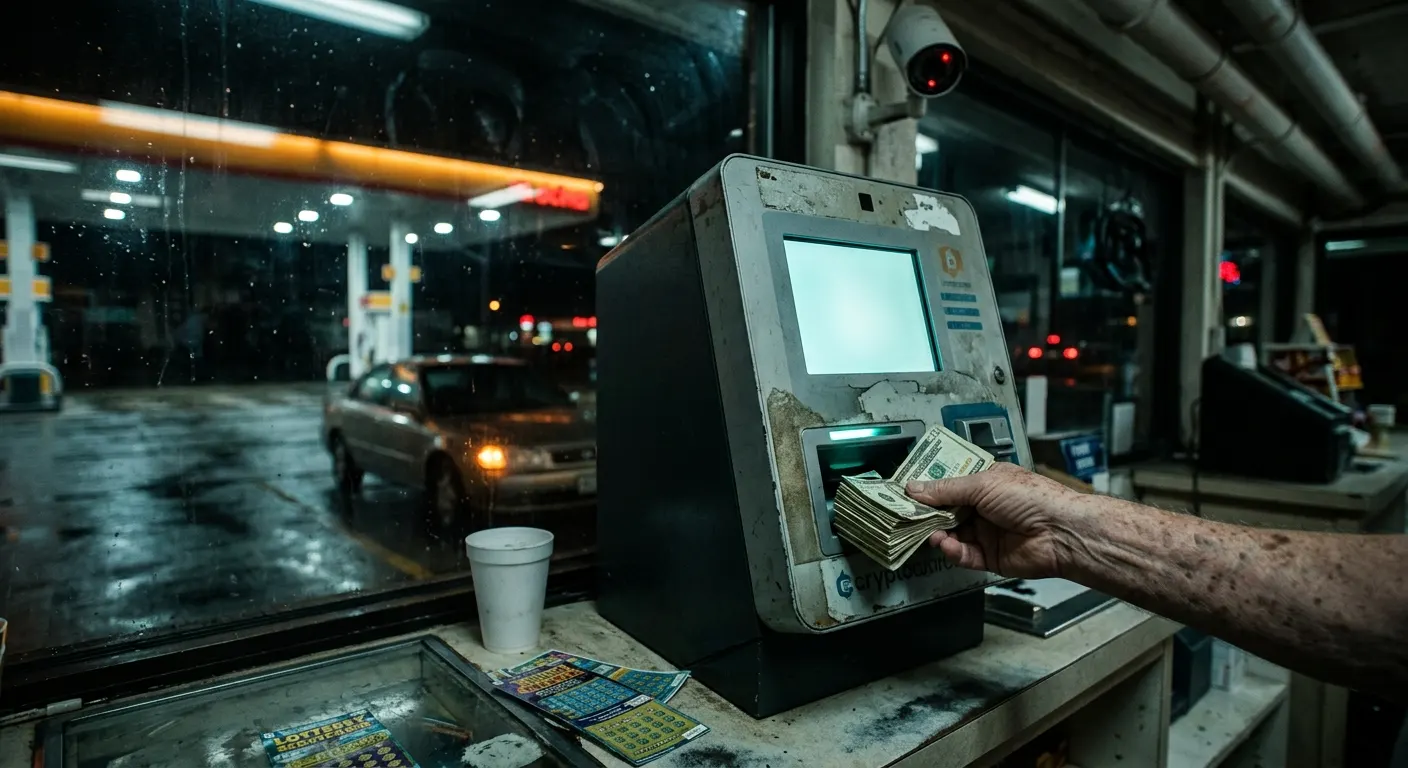
The final step of a modern scam often isn’t a wire transfer or a gift card. It’s a machine humming quietly next to the lottery tickets at a gas station: a cryptocurrency ATM. The victim arrives clutching cash — sometimes tens of thousands of dollars withdrawn on instructions from a “federal agent” or “bank investigator” — scans a QR code the scammer sent, and feeds bills into the slot. Within minutes, the money is cryptocurrency in a wallet controlled by someone on the other side of the world. There is no teller to intervene, no fraud department to call, and almost never a way to get it back.
A Growing Toll, Concentrated on Older Americans
The numbers keep climbing. According to FBI figures, Americans have filed more than 13,400 complaints involving cryptocurrency ATMs, with losses topping $388 million — and losses are growing at roughly 58% per year. Texas alone accounted for some $57 million in reported kiosk losses in 2025, with Florida close behind at $33 million.
The victims skew dramatically older. In cases where the victim’s age was known, adults 60 and older accounted for 86% of losses. The Federal Trade Commission has reported the same pattern for years: older consumers make up a wildly disproportionate share of Bitcoin ATM fraud, both because scammers deliberately target them and because the schemes that funnel victims to kiosks — government imposters, tech support fraud, romance scams — are the ones that hit seniors hardest.
Why Scammers Love the Kiosk
The machine is the perfect getaway car. Crypto ATMs solve the biggest logistical problem in fraud: moving stolen money quickly and irreversibly. A bank wire can be recalled. A gift card can sometimes be frozen. But cash converted to crypto at a kiosk lands in the scammer’s wallet almost instantly and can be laundered through mixers and exchanges within the hour.
The playbook is standardized. Whatever the opening story — a fake fraud alert from your bank, a “missed jury duty” call from the sheriff’s office, a virus warning from “Microsoft,” an online sweetheart with an emergency — the ending is the same. The scammer keeps the victim on the phone, directs them to withdraw cash, sends a QR code for the deposit wallet, and coaches them past any warnings on the screen. In one North Carolina case, a Cary woman lost thousands after a caller posing as a Wake County court official convinced her she’d missed jury duty and had to pay a “bond” through a crypto kiosk to avoid arrest.
The fees add insult to injury. Kiosk operators typically charge markups and fees that can run 15–25% per transaction — meaning even the machine takes a cut of a fraud victim’s life savings on the way out the door.
The Regulatory Wave: Limits, Warnings, and Outright Bans
Statehouses have noticed. Since 2023, 30 states have enacted legislation regulating crypto kiosks — and 13 of those laws passed in 2026 alone, making this the fastest-moving consumer protection front in the country.
The toolkit varies by state. Common provisions include daily transaction limits (California’s $1,000 daily cap for new customers is frequently cited as a model), mandatory on-screen and printed fraud warnings, receipt requirements listing wallet addresses and fees, licensing for operators, and — critically — refund mandates that require operators to reimburse new customers who report fraud within a set window.
Some states have gone further. In 2026, Indiana became the first state to ban cryptocurrency kiosks statewide, citing fraud risks that outweighed the machines’ benefits. Tennessee and Minnesota have since followed with bans of their own. Operators have responded by pulling machines from restrictive markets entirely — one reason crypto ATMs are quietly disappearing from storefronts across the US and Europe this year.
Washington is circling. In Congress, Reps. Sean Casten and María Elvira Salazar introduced bipartisan legislation to protect seniors from crypto ATM scams with federal transaction limits, disclosure requirements, and refund rights — an attempt to set a national floor under the state-by-state patchwork.
The Argument Operators Make — and Its Limits
Industry says the machines serve the unbanked. Kiosk operators argue their products give cash-based customers access to digital assets and that they’ve added warning screens, blocklists of known scam wallets, and compliance teams. Some genuinely have. But consumer advocates, including AARP, counter that the business model still profits from exactly the transactions regulators are worried about: large, first-time cash deposits by older customers who arrived with a stranger on the phone — the single highest-risk fraud profile that exists.
Protecting Yourself
No legitimate organization takes payment at a crypto ATM. Not the IRS, not the Social Security Administration, not your bank, not the police, not Microsoft. The moment anyone directs you to a cryptocurrency kiosk to pay a fine, secure your money, fix a computer, or bail out a loved one, you are talking to a criminal. Hang up.
Break the phone tether. Scammers keep victims on the phone from the first call through the deposit precisely so no one can talk sense into them. If a caller insists you stay on the line while you withdraw or deposit money, that alone is proof of fraud.
Never scan a QR code someone sent you into a kiosk. That code is the scammer’s wallet. Once cash goes in, it’s gone.
Talk to the older adults in your life. With 86% of losses hitting people over 60, a five-minute conversation about jury duty calls, fake fraud alerts, and “federal safety lockers” is one of the highest-value scam defenses that exists.
If it happens, report fast. Contact local police and file a report at ic3.gov immediately — and if your state has a kiosk refund law, notify the ATM operator in writing right away, since refund windows for new customers can be as short as 14 days.