Imagine asking Google’s AI assistant about a new cryptocurrency investment. It answers your questions confidently, shows you projected returns, and walks you through exactly how to buy in. The interface looks professional. The branding looks legitimate. The AI sounds knowledgeable.
There’s just one problem: none of it is real.
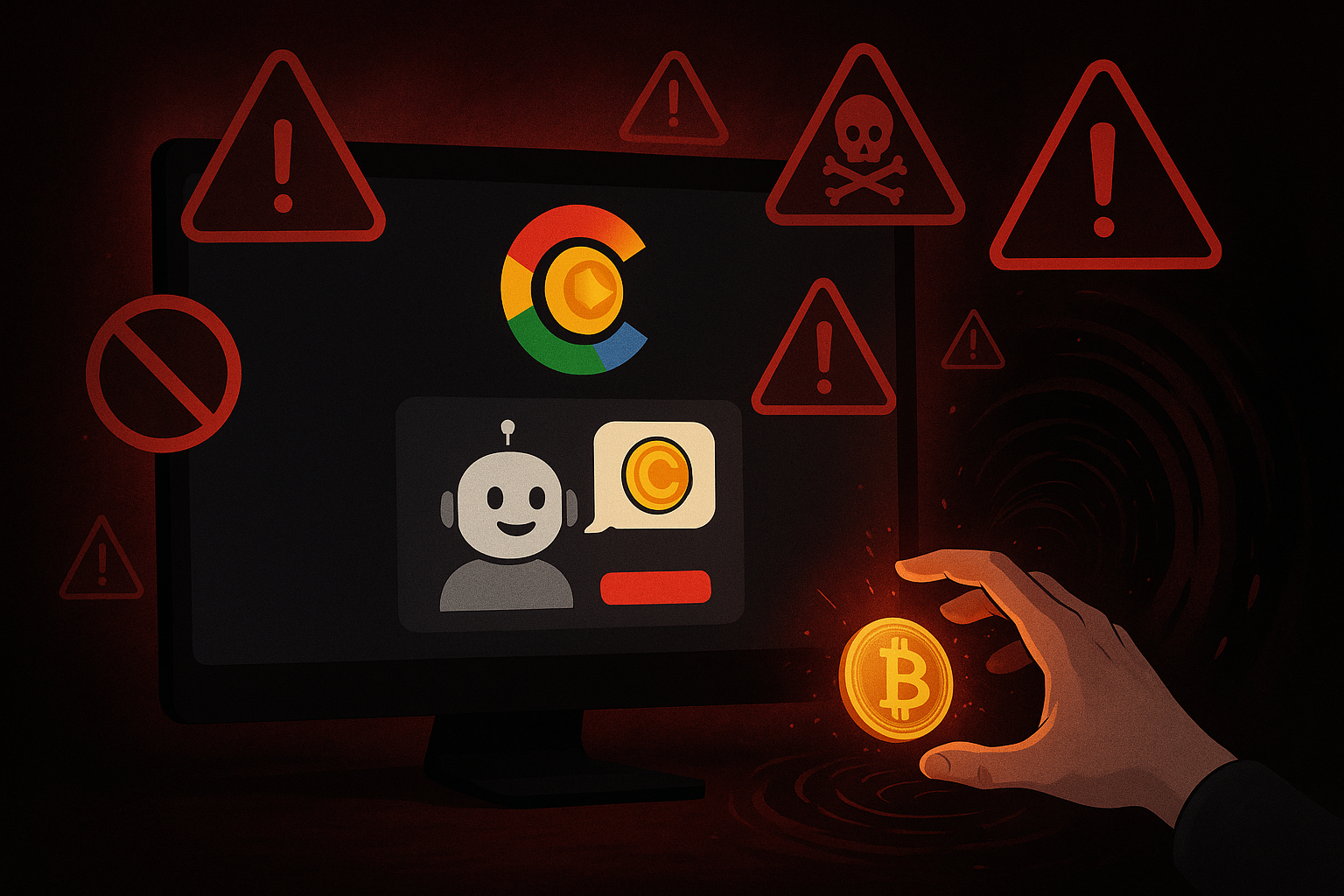
Security researchers at Malwarebytes have uncovered a sophisticated crypto scam that combines brand impersonation with artificial intelligence to create one of the most convincing fraud operations we’ve seen in 2026. The scam promotes a fake cryptocurrency called “Google Coin” through a polished website featuring a chatbot that claims to be Google’s Gemini AI assistant.
Google does not have a cryptocurrency. There is no “Google Coin.” And that helpful AI assistant guiding you through your “investment” is a script designed to take your money and disappear.
How the Google Coin Scam Works
Step 1: The Professional-Looking Website
The scammers created a website that mimics Google’s visual design — clean layouts, familiar color schemes, professional typography, and Google-style branding elements. At first glance, it could pass for a legitimate Google product page.
The site promotes “Google Coin” as a new cryptocurrency backed by Google, currently in a “presale” phase where early investors can buy tokens at a discount before the coin is listed on major exchanges.
Step 2: The Fake AI Chatbot
This is where the scam gets dangerously clever. The site features an interactive chatbot that introduces itself as “Gemini, your AI assistant for the Google Coin platform.” It uses Google’s familiar AI branding to establish instant credibility.
When visitors ask questions, the chatbot gives specific financial projections. In one interaction documented by Malwarebytes, the bot claimed that buying 100 tokens at $3.95 each (a $395 investment) could turn into more than $2,700 once the coin was “listed” — a 7x return.
The chatbot is programmed to:
- Answer investment questions confidently with specific dollar figures
- Deflect skepticism — if you ask whether it’s a scam, it reassures you with vague promises about security and transparency
- Refuse to acknowledge risk — unlike legitimate financial tools, it never mentions the possibility of loss
- Guide you to payment — it walks you step-by-step through sending cryptocurrency to a wallet address
Step 3: The Irreversible Payment
When you click “Buy,” you’re instructed to send Bitcoin to a specific wallet address. The site displays fake progress counters showing millions of tokens “already sold” and countdown timers creating artificial urgency.
Once you send cryptocurrency, it’s gone forever. There’s no customer support to call. No chargeback process. No refund mechanism. Your money is in the scammer’s wallet, and the transaction is recorded permanently on the blockchain — but the wallet belongs to a thief, not to Google.
Why This Scam Is More Dangerous Than Most
AI Makes Scams Interactive
Traditional crypto scams rely on static websites — you read the pitch, decide to invest or not. The Google Coin scam adds a real-time conversational element that fundamentally changes the dynamic.
When a chatbot answers your specific questions, addresses your concerns, and provides personalized investment projections, it creates a false sense of due diligence. You feel like you’ve “researched” the investment because you asked questions and got answers. But you were talking to a script designed to say whatever it takes to get you to send money.
AI Scams Scale Infinitely
A human scammer can only talk to one victim at a time. An AI chatbot can handle hundreds of simultaneous conversations, each one personalized and persuasive. The scam runs 24/7 without breaks, never gets frustrated, and never goes off-script.
This is the terrifying efficiency of AI-powered fraud: the same polish and persuasion that makes legitimate AI assistants useful makes scam chatbots devastatingly effective.
Brand Impersonation Exploits Trust
Most people trust Google. When something looks like a Google product and features what appears to be Google’s AI assistant, the default assumption is legitimacy. Scammers exploit this implicit trust transfer — you’re not just trusting a random website, you’re (falsely) trusting Google.
The Bigger Picture: AI-Powered Scams Are Exploding
The Google Coin scam isn’t an isolated incident. It’s part of a rapidly growing trend of AI-enhanced fraud:
DOJ Seizes $61 Million from Pig Butchering Scams (March 2026)
Just this week, the Department of Justice announced the seizure of $61 million in USDT tied to pig butchering cryptocurrency scams. These schemes — which use long-term social engineering to build fake relationships before directing victims to fraudulent trading platforms — are increasingly incorporating AI chatbots to automate the relationship-building phase.
According to TRM Labs’ 2026 Crypto Crime Report, $35 billion was sent to fraud schemes in 2025 alone. Pig butchering scams account for a substantial portion and represent “one of the most financially devastating fraud typologies” in cryptocurrency.
UK Government’s Fraud Strategy 2026-2029
The UK government released its new Fraud Strategy this month, specifically flagging rising crypto crimes and the role of AI in enabling more sophisticated fraud operations.
Crypto ATM Warning Signs
Cities are fighting back at the ground level. Gladstone, Missouri recently passed an ordinance requiring crypto ATMs to display warning signs asking customers “Are you being scammed?” — a response to the surge in victims being directed to crypto ATMs by scammers.
Singapore’s Savvy Investors Getting Fooled
Even experienced cryptocurrency investors aren’t immune. A report from Singapore details how Mark Koh, an investor with eight years of crypto experience who helped defrauded traders, was himself fooled by a sophisticated scam — proving that overconfidence in your ability to spot fraud is itself a vulnerability.
How to Protect Yourself
The Golden Rule: Verify Before You Send
Before sending cryptocurrency to any investment opportunity:
-
Go directly to the company’s official website. If Google launched a cryptocurrency, it would be on google.com, announced in major news outlets, and covered by every financial publication in the world. If you can’t find it on the company’s real domain, it’s fake.
-
Google the investment + “scam.” A simple search for “Google Coin scam” would have immediately revealed warnings. Take 30 seconds to search before sending money.
-
Never trust guaranteed returns. No legitimate investment can promise your money will multiply by 7x. If a chatbot gives you specific return projections with no mention of risk, you’re being scammed.
Red Flags to Watch For
🚩 Countdown timers and urgency — “Only 2 hours left in the presale!” Scammers create artificial time pressure to prevent you from thinking critically.
🚩 Specific return guarantees — “$395 becomes $2,700” is not an investment projection. It’s a lie.
🚩 AI chatbot that deflects questions about risk — Any legitimate financial tool will acknowledge that investments can lose value. If the chatbot only talks about gains, it’s a sales script.
🚩 Payment only in cryptocurrency — Legitimate companies accept credit cards, bank transfers, and other reversible payment methods. Crypto-only payments mean no refunds, ever.
🚩 No verifiable company registration — Real investment products are registered with the SEC, FCA, or other financial regulators. If you can’t find regulatory filings, walk away.
🚩 Too-good-to-be-true presale pricing — “Get in before the listing!” is the crypto equivalent of “Act now and save!” It’s a pressure tactic, not an investment opportunity.
What to Do If You’ve Been Scammed
If you’ve already sent cryptocurrency to a scam:
- Report immediately — File a complaint with the FBI’s Internet Crime Complaint Center (IC3.gov) and the FTC (ReportFraud.ftc.gov)
- Save everything — Screenshots of the website, chatbot conversations, wallet addresses, transaction IDs, and any emails or messages
- Report the wallet address — Submit it to Chainabuse.com so it can be flagged for other potential victims
- Contact your crypto exchange — If you sent funds from an exchange, report the fraud immediately. Some exchanges can flag receiving addresses
- Don’t engage with “recovery” services — Scammers often run secondary scams targeting people who’ve already been defrauded, promising to “recover” your stolen crypto for an upfront fee
The Bottom Line
The Google Coin scam represents the next evolution of crypto fraud: AI-powered, brand-impersonating, and conversationally persuasive. As AI tools become more sophisticated, expect scammers to deploy increasingly convincing chatbots that impersonate not just Google, but banks, government agencies, and financial institutions.
The best defense hasn’t changed: slow down, verify independently, and remember that if something sounds too good to be true — especially when an AI chatbot is telling you about it — it absolutely is.
Scam Watch HQ monitors emerging fraud tactics and scam operations. If you’ve encountered a scam, report it and help protect others. Follow us at scamwatchhq.com for the latest alerts.