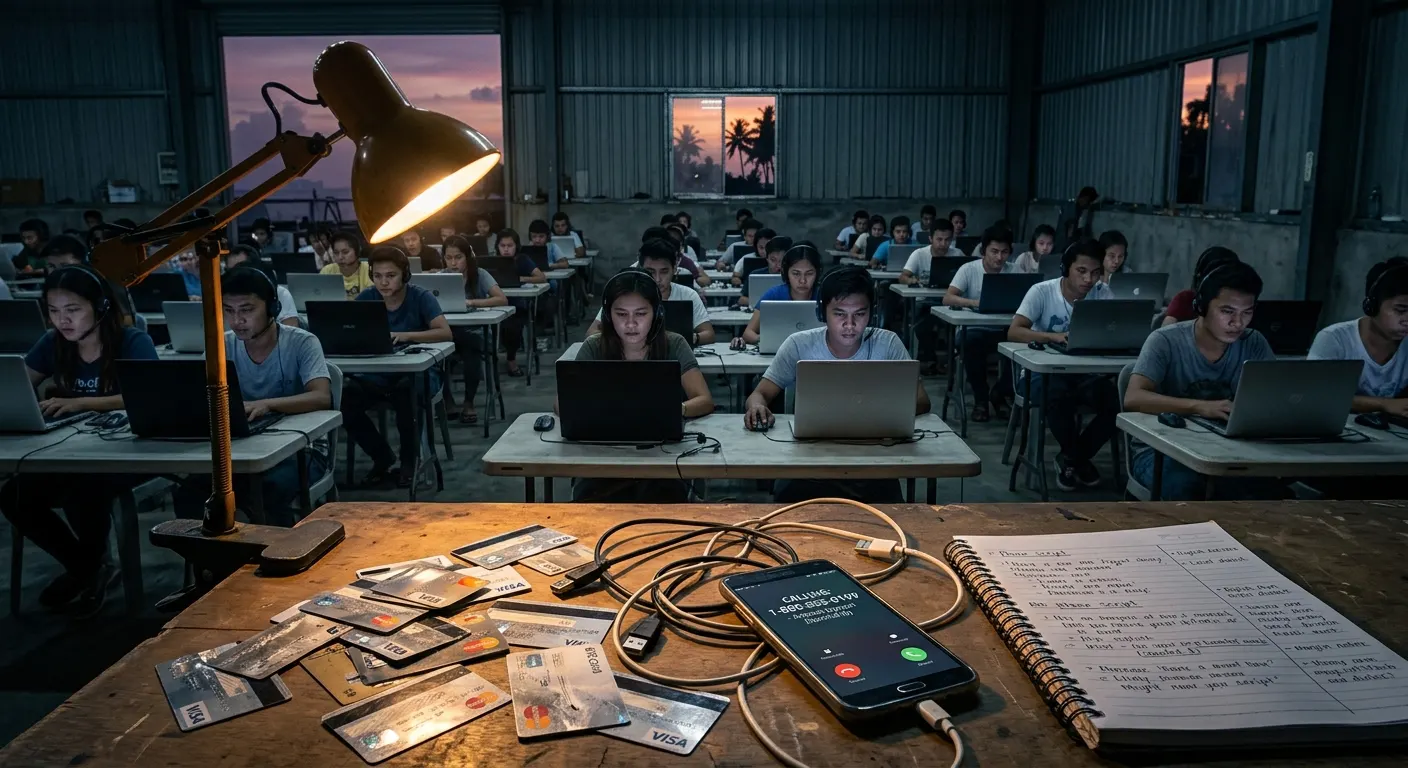
The call came through on a Sunday afternoon, the caller ID showing the customer service number of a major US bank. The voice on the other end was calm, professional, and concerned: there had been suspicious activity on the account. To protect the funds, the customer needed to purchase gift cards and read the numbers over the phone.
The “bank representative” was in Goa.
On May 28, 2026, Indian law enforcement officers raided a call center operating out of the Verna Industrial Estate in South Goa and arrested 26 individuals who had been running this exact scheme — spoofing legitimate US bank phone numbers and systematically defrauding American victims through gift card payment demands.
What Investigators Found
The physical evidence recovered from the Verna Industrial Estate operation illustrates the operational scale of even a mid-sized fraud call center:
- 145 laptops
- 45 mobile phones
- Networking equipment and VoIP hardware
- Total equipment value approximately ₹55 lakh (~$66,000)
The suspects had been recruited from seven Indian states: Nagaland, Assam, West Bengal, Bihar, Madhya Pradesh, Gujarat, and Maharashtra — reflecting the call center’s role as an employer of last resort for young workers willing to participate in fraud schemes that pay more than legitimate entry-level work.
Part of a Much Larger Operation
The Verna bust was not isolated. Indian investigators connected it to a $48 million fraud scheme that has targeted more than 650 Americans since 2022 — a four-year operation linked to multiple call centers across Goa.
This was also the second major Goa call center bust in five weeks. On April 24, 2026, nine individuals were arrested in Verem, Goa in a nearly identical operation — spoofing US banks and Apple support staff to extract gift card payments from American victims. The April raid was linked to an earlier FBI-India joint operation that had dismantled three call centers connected to the same broader fraud network.
The pattern is consistent: Goa has become a regional hub for US-targeted fraud call centers, with operations that share infrastructure, recruitment pipelines, and apparent organizational connections even when they operate from different addresses.
How the Scam Works
The bank impersonation gift card scam is one of the most durable fraud operations targeting Americans, because it exploits trust in legitimate institutions combined with the urgency psychology that fraud operations cultivate.
The script is typically:
- Caller ID spoofs the genuine customer service number of a major bank (Chase, Bank of America, Wells Fargo, Citibank)
- “Representative” explains there has been fraudulent activity on the account
- To “protect” funds, the customer must purchase gift cards at a local retailer (Apple, Google Play, Amazon, Target)
- Customer reads the gift card redemption codes to the “representative”
- Codes are immediately redeemed through digital accounts, and the value is converted to cryptocurrency
Gift cards are the preferred payment vehicle because they are irreversible, untraceable once redeemed, and available at nearly every US retailer. Unlike wire transfers, there is no bank review step. Unlike cryptocurrency, they do not require technical knowledge.
The US Data Behind the Pattern
The scale of this fraud category in the US is documented in FBI IC3 data. In 2025:
- Government and bank impersonation scams generated over 32,400 complaints across all age groups
- Losses in the category totaled approximately $798 million
- The median loss per victim who contacted a scammer by phone was $2,210 — higher than any other contact method
Older Americans are disproportionately targeted. The combination of a familiar institutional name, a calm authoritative voice, and a financial threat creates a stress response that overrides skepticism — particularly for victims who have maintained a relationship with a specific bank for decades.
The Enforcement Picture
The Goa busts reflect a broader pattern of Indian law enforcement taking US-targeting fraud operations more seriously, partly driven by formal FBI cooperation agreements and partly by domestic political pressure to address the reputational damage that call center fraud has created for India’s legitimate outsourcing industry.
From the US side, the FBI’s Transnational Elder Fraud Strike Force — which coordinates international enforcement against operations specifically targeting older Americans — has been active in generating the referrals and evidence packages that support Indian police action.
The challenge is structural: call centers can be set up and operational in days. The workers arrested in Goa will be replaced by a new cohort recruited from the same states through the same channels within weeks. The enforcement cost of a raid disrupts one node in a network that rebuilds itself continuously.
The DOJ has addressed this by pursuing the managers and organizers rather than the frontline workers — a prosecution strategy that aims at the people who cannot be replaced as easily. But with 26 arrests in Goa, the immediate beneficiaries are the hundreds of American victims who will not receive a call from this particular operation tomorrow.