Executive Summary: A Criminal State Within a State
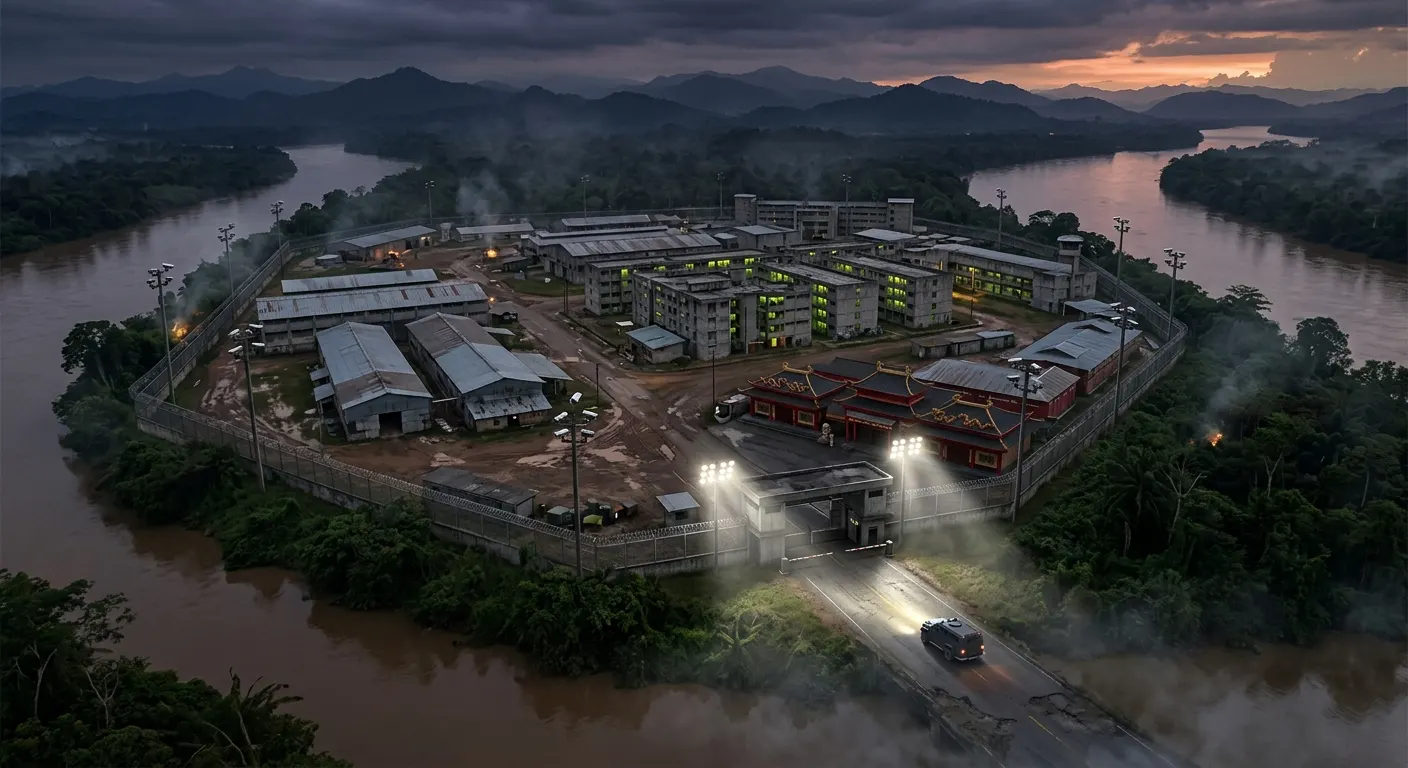
Cambodia has “Scambodia.” Myanmar has its Shan State compounds. But the most entrenched, most legally complex, and in many ways most alarming scam compound operation in Southeast Asia sits in Laos — in a 3,000-hectare zone along the Mekong River that operates under a 99-year lease from the Lao government, controlled by a sanctioned Chinese triad-linked operator, and governed by rules that no national authority — not Laos, not China — can easily enforce.
The Golden Triangle Special Economic Zone (GTSEZ) in Bokeo Province, Laos is not simply a scam compound. It is a blueprint for criminal sovereignty: a functioning quasi-state with its own law enforcement, its own currency acceptance, its own telecommunications infrastructure, and its own rules — where gambling, drug trafficking, human trafficking, and online fraud operate with minimal outside interference, generating an estimated $64 billion annually in illicit activity.
That figure — $64 billion — represents an estimated 70% of Laos’s entire GDP. Laos is not hosting a fraud operation. Laos has, in the GTSEZ, something that looks structurally like a criminal co-sovereign operating on its territory.
The GTSEZ: Origins and Architecture
The Golden Triangle Special Economic Zone was established in 2007 through a contract between the Lao government and Kings Romans Group — a Hong Kong-registered company whose primary known figure is Zhao Wei, a Chinese businessman with documented connections to the Triad criminal network.
Under the contract, Kings Romans Group obtained a 99-year lease on the GTSEZ land in Ton Pheung District, Bokeo Province. The zone covers approximately 3,000 hectares — roughly the size of a small city. The agreement granted the zone operator significant autonomy over internal governance, security, and economic activity.
The US Treasury Department sanctioned Kings Romans, Zhao Wei, and the “Zhao Wei Transnational Crime Organization” in January 2018, alleging the casino and surrounding zone were used to launder money, traffic drugs, and facilitate other serious transnational crimes. The sanctions prohibit US persons and entities from transacting with the sanctioned individuals and organizations — but the GTSEZ continues to operate, largely insulated from these designations by its physical isolation and the jurisdictional vacuum its unique legal structure creates.
The zone sits at the confluence of the Mekong River, at the border meeting point of Laos, Myanmar, and Thailand — the historical “Golden Triangle” region long associated with opium production and the narcotics trade. The geographic location is deliberate: multiple national borders within short distances, river transport routes, and jurisdictional complexity that makes enforcement coordination between three countries legally and practically difficult.
Scam Compound Operations: Scale and Methodology
The GTSEZ and surrounding areas in Bokeo Province have become one of the major concentration points for cyber scam operations in Southeast Asia — hosting, alongside the traditional casino and narcotics economy, large-scale pig-butchering fraud operations staffed by trafficked workers from across Asia, Africa, and beyond.
The Workforce: Trafficked Into Fraud
Al Jazeera’s 2025 documentary investigation traced individual workers from Nigeria and other African countries who were recruited with promises of data entry or customer service jobs in Southeast Asia, transported to Laos, and found themselves in locked compounds conducting cryptocurrency investment fraud against victims worldwide.
The US State Department’s 2025 Trafficking in Persons Report documented that traffickers use the internet and social media to “fraudulently recruit men, women, and children from Laos and other countries for relatively well-paying technical jobs and, instead, force them to engage in online gambling, internet, cryptocurrency, and telephone or online scams, primarily in casinos and commercial compounds in Laos.”
A 2025 worker strike inside the GTSEZ — reportedly over unpaid wages and passport confiscation — ended with external police detaining the organizers and withholding their pay and travel documents. Even attempted collective action by workers is suppressed.
Workers are multilingual, digitally skilled, and forced to work 15 to 17 hours daily under threat of violence. Those who fail to meet fraud quotas face punishment — physical beatings, food deprivation, or being “sold” to other compound operators. Those who attempt to escape face armed security and a geographic environment with limited options: the zone’s position along the Mekong, accessible primarily by controlled river transport, limits informal exit.
The Operations: Sophisticated, Persistent, Global
The fraud operations running from GTSEZ compounds are not rudimentary. They are:
- Pig-butchering campaigns targeting American, European, and Australian victims through dating apps, LinkedIn, and social media platforms, running months-long relationship-building operations before the investment pitch
- Crypto investment fraud using sophisticated fake platforms with professional interfaces, fabricated trading histories, and customer support infrastructure
- Romance scams using AI-enhanced personas — realistic profile photos, consistent backstories, AI-assisted messaging — to target victims across all demographics
- Technical support fraud targeting older victims in English-speaking markets
- Investment scheme fraud targeting Chinese diaspora communities globally — a segment where GTSEZ operators have particular language capability and cultural knowledge
The operations use rotating pools of workers, rotating target geographies, and rotating platform domains to stay ahead of platform takedowns and law enforcement disruption.
The Jurisdictional Void
The GTSEZ’s legal structure creates a genuine enforcement paradox that has resisted resolution for nearly two decades:
Lao jurisdiction is limited by contract. The 99-year lease with Kings Romans Group granted significant internal autonomy. Lao law enforcement entry into the zone requires coordination with zone security — controlled by the same operators running the criminal enterprises. Lao government officials have stated publicly that the zone creates significant challenges for enforcement.
Chinese jurisdiction doesn’t apply. Despite the predominantly Chinese-national ownership and management of GTSEZ operations, Chinese law has no authority over what occurs in nominally Lao territory. China’s domestic crackdown on scam operations has pushed operators to countries like Laos precisely because Chinese law cannot follow them.
US sanctions have limited reach. Treasury sanctions prevent US persons from transacting with Zhao Wei and Kings Romans Group — but the operations are largely insulated from direct US financial system access and operate through alternative payment infrastructure.
Thailand and Myanmar border proximity. Workers and operators can transit to Thai territory or Myanmar quickly — fragmenting law enforcement pursuit across three national jurisdictions simultaneously.
The result is what researchers from GreyDynamics call a “gray zone”: a space where criminal activity operates with official complicity (or at minimum official passivity) from the host government, insulated from external jurisdiction by a combination of law, geography, and corruption.
Laos as Both Host and Victim
It is important to note that Laos is not only a host country for fraud infrastructure targeting foreigners. Ordinary Lao citizens are themselves increasingly victimized:
- Domestic internet fraud has grown substantially with Laos’s rapid mobile internet expansion, with Facebook-based commerce fraud, fake investment schemes, and impersonation scams targeting the Lao population
- Lao workers are trafficked into compounds alongside foreign nationals — young Lao people recruited with false job promises end up working as fraud operators in conditions they cannot leave
- Remittance fraud targeting the Lao diaspora in Thailand and Australia has grown as organized criminal networks exploit community networks
The UN Office on Drugs and Crime noted in a February 2026 report that “the human cost of cyber scam operations in South-East Asia” falls disproportionately on people from the region’s most economically vulnerable populations — including Lao nationals who lack the social capital or legal resources to seek help when trafficked.
Recent Developments: 2025–2026
2,800 arrests in the GTSEZ since 2023. Lao officials announced in February 2026 that nearly 2,800 suspects had been arrested in the Golden Triangle Zone since 2023 — a significant figure, though observers note that most of those arrested are low-level workers rather than the operators and organizers who run the operations.
Relocation, not dissolution. The “whack-a-mole” dynamic documented by the East Asia Forum in April 2026 applies directly to the GTSEZ: crackdowns in Myanmar push operators into Laos; pressure in Cambodia pushes operators toward Laos and the Philippines. The GTSEZ’s structural protections — the 99-year lease, the jurisdictional complexity, the physical isolation — make it more resistant to displacement than compound operations in other countries.
Expansion plans. Planning documents reviewed by researchers envision the GTSEZ growing to 300,000 residents by 2026 — up from perhaps tens of thousands currently — with planned expansion through facilities including an “E-cigarette Industry Base” and “Big Health Medical Industrial Park,” descriptions that researchers and law enforcement read as potential covers for expanded criminal operations.
Key Statistics
| Metric | Figure |
|---|---|
| GTSEZ area | ~3,000 hectares |
| GTSEZ lease term | 99 years (from 2007) |
| Estimated illicit activity generated | $64B annually |
| Illicit activity as % of Laos GDP | ~70% |
| Regional scam compound workers (UN estimate) | 300,000+ |
| GTSEZ arrests since 2023 | ~2,800 |
| US Treasury sanctions on Kings Romans | January 2018 |
Protecting Yourself
The GTSEZ and Laos-based compound operations run the same fraud methodologies documented everywhere in Southeast Asia — pig-butchering, romance fraud, investment fraud, crypto scams — but with particular operational depth and resilience.
Key red flags for GTSEZ-linked fraud:
- Online investment platforms with professional interfaces but no verifiable regulatory registration
- “Relationships” that began online and move quickly to investment topics
- Cryptocurrency platforms that show consistent gains but develop obstacles to withdrawal
- Customer service contacts that operate with unusual fluency across multiple languages
The broader protection framework is unchanged: report to ic3.gov (US), action fraud (UK), or your national fraud reporting body. Never invest through platforms introduced by someone you have not met in person and independently verified.
Sources: Al Jazeera: Trapped in Cyber Scam Centre in Laos · East Asia Forum: Southeast Asia’s whack-a-mole scam economy · US State Dept 2025 TIP Report: Laos · OHCHR: Human Cost of Cyber Scam Operations · Not For Sale: GTSEZ Case Study · Bloomberg: Golden Triangle Crypto Scammers · Laotian Times: 2,800 Arrests