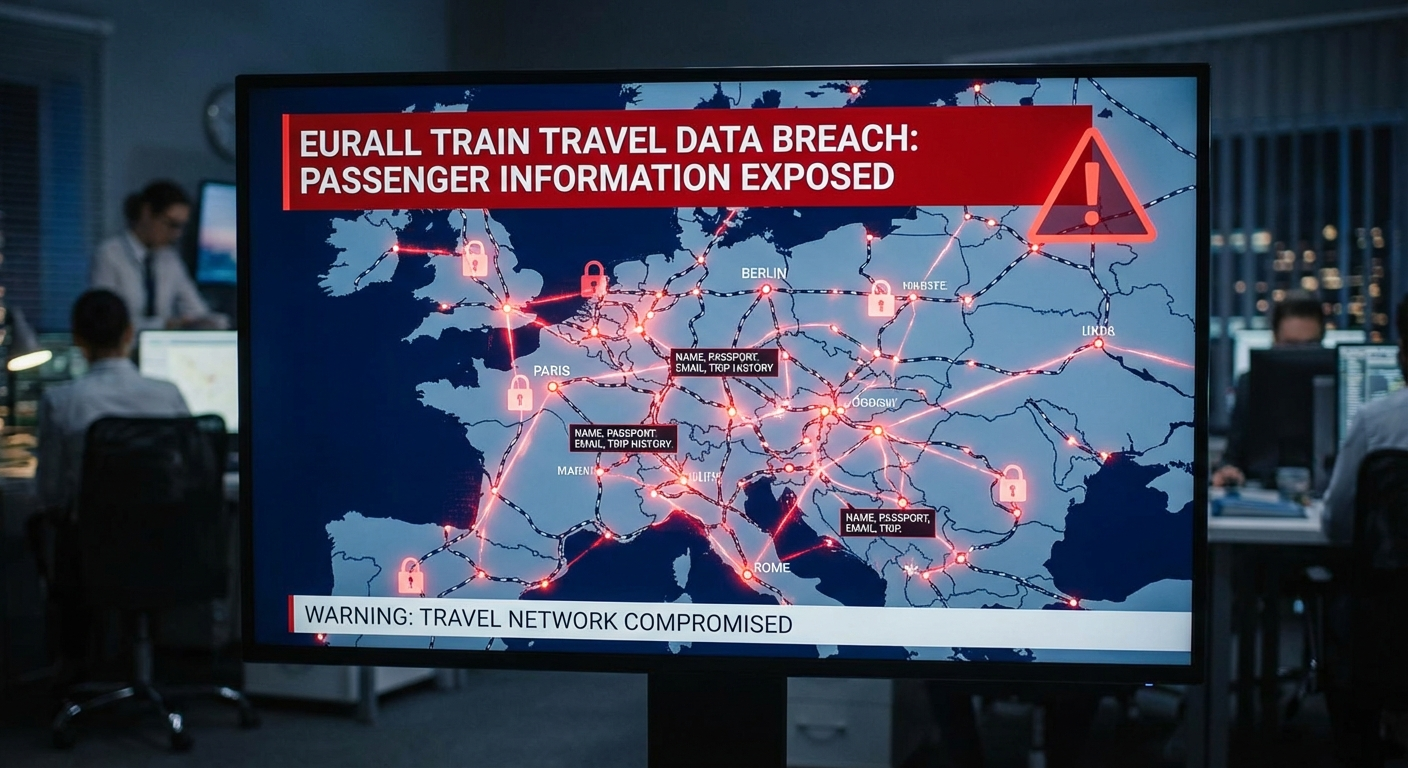
BREAKING: Cybercriminals are actively advertising stolen Eurail user records on underground forums, putting millions of travelers at immediate risk of sophisticated phishing attacks, identity theft, and travel-related fraud schemes that could ruin dream vacations across Europe.
The Breach: A Treasure Trove for Scammers
In what security researchers are calling one of the most significant travel industry breaches in recent history, hackers have gained access to a massive database of Eurail customer information and are now openly marketing the data to fraudsters specializing in travel scams. The timing couldn’t be worse—just as Europe enters peak tourism planning season.
Sources in the cybersecurity community report that the stolen database includes:
- Full names and contact information- Email addresses and phone numbers- Travel itineraries and booking dates- Payment card information (potentially partial)- Passport numbers and nationalities- Home addresses- Account credentials
“This is a scammer’s goldmine,” explains Dr. Elena Vasquez, director of the European Cybercrime Research Institute. “You’re not just looking at financial data—you’re looking at detailed travel plans, personal identifiers, and behavioral patterns that can be weaponized in countless ways.”
How Travelers Are Being Targeted
Within hours of the data appearing on dark web marketplaces, security firms began detecting sophisticated phishing campaigns targeting Eurail customers. The scams are alarmingly convincing because attackers have access to real booking information.
The Fake Cancellation Scam
Travelers receive emails that appear to come from Eurail or national rail operators, claiming their pass has been suspended due to a “technical error” or “payment issue.” The message includes legitimate booking details—dates, routes, pass types—making it appear authentic.
“I got an email saying my Eurail pass for my daughter’s graduation trip was cancelled,” shares Margaret Thompson, a mother from Manchester planning a June trip across Europe. “It had our exact travel dates and the confirmation number. They wanted me to ‘verify’ my payment information within 24 hours or lose the booking entirely. It felt urgent, real. I almost clicked.”
The links in these emails lead to convincing replica websites that harvest credit card information, login credentials, and personal data. Some variants deploy malware designed to monitor online banking activity.
The Accommodation Upsell Scheme
Armed with travel itineraries, scammers are contacting victims directly via phone and email, posing as “Eurail travel partners” offering discounted hotels and accommodations along their planned routes.
“They knew I was traveling from Amsterdam to Vienna to Prague,” recounts James Chen, a San Francisco-based software engineer. “They offered a ‘Eurail partner discount’ on hotels in all three cities. The prices seemed reasonable, I paid through what looked like a legitimate booking platform, and of course, when I arrived in Amsterdam, there was no reservation.”
These scams work because the fraudsters have something genuine companies usually don’t: your exact travel plans.
The Route Change Extortion
Perhaps most troubling is a new variant where scammers contact travelers claiming there are “service disruptions” or “track maintenance” on their planned routes. They offer to “rebook” victims on alternative trains—for a “small administrative fee.”
“It’s psychological warfare,” explains cybersecurity analyst Marcus Weber. “You’ve planned this trip for months, maybe years. You’re departing in two weeks. Someone calls with your booking details saying there’s a problem. Your natural instinct is to fix it, not to skeptically verify every detail.”
The Underground Marketplace: Inside the Trade
Scam Watch Hub investigators have been monitoring dark web forums where the Eurail data is being sold. The economics are sobering:
- Bulk packages: 100,000 records for $15,000 USD- Targeted packages: Records filtered by travel dates, nationalities, or destinations command premium prices- “Fresh” data: Recently stolen information sells for 3-4x more than older breaches- Value-added services: Some sellers offer “pre-validated” records where email addresses and phone numbers have been confirmed as active
The forums reveal professional fraud operations with specializations. Some groups focus exclusively on accommodation scams, others on payment fraud, and sophisticated operators run multi-stage schemes that extract value from victims over weeks or months.
“You’re seeing organized crime syndicates applying business principles to data breach exploitation,” notes Interpol cybercrime investigator Antoine Rousseau. “They have customer service, money-back guarantees if data proves invalid, and even tutorials for buyers on how to maximize return on investment.”
The Cascading Risk: Beyond Travel Fraud
While travel scams are the immediate threat, security experts warn that the Eurail breach has far-reaching implications:
Identity Theft at Scale
Passport numbers combined with travel patterns create detailed identity profiles. Fraudsters are using this information to:
- Apply for credit cards and loans in victims’ names- Create fake identity documents- Impersonate travelers at borders or during international transactions- Build synthetic identities by combining multiple victims’ data
“A passport number isn’t like a credit card—you can’t just cancel it and get a new one,” explains identity theft specialist Dr. Priya Sharma. “For many victims, this breach will create problems that persist for years.”
Corporate Espionage
Business travelers who used Eurail for corporate trips represent a secondary target. Their travel patterns can reveal:
- Which companies are expanding into which European markets- Conference attendance and competitive intelligence gathering- Executive movements and meeting schedules- Supply chain relationships and partnership activities
Several major consulting firms and tech companies have already issued internal warnings to employees who traveled using Eurail passes.
Physical Security Threats
Perhaps most concerning are the physical security implications. Knowing someone’s travel itinerary and home address creates opportunities for:
- Targeted home burglaries while residents are abroad- Stalking or harassment of travelers at known locations- Physical intimidation or assault in cases of high-value targets- Smuggling operations using travelers’ luggage or identities
“We’re seeing an erosion of the boundary between cyber and physical threats,” warns European Commission security advisor Klaus Hoffmann. “A data breach doesn’t just compromise your bank account—it can compromise your safety.”
What Went Wrong: The Security Failure
While Eurail has not officially confirmed the breach, security researchers have identified several potential vulnerabilities:
Legacy Systems
The Eurail system integrates with dozens of national rail operators across Europe, many using infrastructure built decades ago. “Interoperability is prioritized over security,” explains railway IT consultant Francesca Rossi. “These systems were designed in an era when the threat landscape was completely different.”
Third-Party Integration Points
Eurail works with numerous booking platforms, travel agencies, and payment processors. Each integration point represents a potential attack vector.
“You can have Fort Knox security on your main database, but if a third-party vendor with access is using weak authentication, you’re vulnerable,” notes penetration tester David Liu. “Attackers always look for the weakest link.”
Insufficient Monitoring
Early indicators suggest the breach may have occurred months ago, with data exfiltrated slowly to avoid detection triggers. This points to inadequate network monitoring and anomaly detection systems.
The Global Context: Travel Industry Under Siege
The Eurail breach is not an isolated incident but part of a disturbing trend targeting the travel and hospitality sector:
- British Airways (2018): 380,000 payment records stolen- Marriott/Starwood (2018): 500 million guest records compromised- EasyJet (2020): 9 million customers affected- SITA (2021): Multiple airlines impacted through shared passenger service systems- Booking.com (ongoing): Continuous phishing campaigns exploiting the platform
“The travel industry is a perfect storm of vulnerability,” explains cybersecurity economist Dr. Rachel Goldstein. “You have high-value data, legacy systems, complex integration requirements, international operations complicating jurisdiction and oversight, and time-sensitive transactions where people make quick decisions.”
The sector invests significantly less in cybersecurity compared to financial services or healthcare, despite handling comparable amounts of sensitive data.
What Travelers Must Do Now
If you’ve used Eurail services—even years ago—security experts recommend immediate action:
Immediate Steps (Do Today)
- Change your passwords for Eurail accounts and any other service using the same credentials2. Enable two-factor authentication wherever possible3. Monitor financial accounts for unauthorized transactions4. Review credit reports for suspicious applications or accounts5. Set up fraud alerts with credit bureaus
Verify All Communications
- Never click links in emails about travel bookings—instead, go directly to the official website- Verify any phone calls by hanging up and calling back using official numbers- Be suspicious of “urgent” requests, especially those demanding immediate payment- Check for subtle domain name misspellings in emails and websites
Document Everything
- Screenshot suspicious communications- Keep records of any fraudulent charges or identity theft attempts- Report incidents to local authorities and national consumer protection agencies- File complaints with data protection authorities (like GDPR authorities in Europe)
Consider Protective Measures
- Credit freeze: Prevents new accounts from being opened in your name- Travel registration: Register upcoming trips with your country’s embassy- Passport monitoring: Some services alert you if your passport appears in breach databases- Privacy services: Consider services that monitor and remove personal information from data broker sites
The Regulatory Response: Too Little, Too Late?
The Eurail breach comes at a critical moment for data protection regulation. Europe’s GDPR has been in effect since 2018, yet major breaches continue with alarming frequency.
“GDPR has teeth—up to 4% of global annual revenue in fines—but enforcement is inconsistent,” argues privacy law expert Dr. Thomas Mueller. “Companies calculate that the risk of a breach fine is worth taking compared to the cost of comprehensive security overhauls.”
Several European Parliament members are now calling for:
- Mandatory breach insurance for companies handling travel data- Real-time breach disclosure requirements (not the current 72-hour window)- Personal liability for executives in cases of negligent security- Standardized security requirements for cross-border transportation systems
“The current system allows companies to externalize the cost of breaches onto consumers,” contends MEP Sofia Andersson. “Victims spend hundreds of hours and thousands of euros dealing with identity theft while the breached company faces at most a fine that’s a rounding error on their balance sheet.”
Industry Accountability: The Trust Deficit
For Eurail and the broader rail industry, this breach represents a critical moment. The affected demographic—often first-time European travelers, students, and families—are exactly the customers rail travel needs to attract away from budget airlines.
“Trust is the foundation of the travel industry,” reflects travel industry analyst Jennifer Park. “When people don’t trust that their data is safe, they’ll either choose alternatives or simply travel less. This breach could have ripple effects across European tourism for years.”
Early indicators are concerning. Online travel forums show travelers discussing:
- Returning to paper-based tickets and cash payments- Avoiding Eurail in favor of point-to-point tickets- Choosing destinations outside Europe entirely- Sharing plans only with immediate family until after travel
Looking Ahead: The New Normal
As investigators continue unraveling the full scope of the Eurail breach, security experts are reaching a sobering conclusion: this won’t be the last major travel industry compromise.
“We’re in the early innings of a long game,” predicts cybersecurity futurist Dr. Amanda Chen. “As travel becomes more digital, more connected, more data-intensive, the attack surface expands exponentially. The industry needs to fundamentally rethink security architecture, not just patch vulnerabilities.”
The integration of AI, biometrics, and interconnected booking systems promises convenience but also creates new exploitation opportunities. A breach in 2026 might expose not just your travel plans but your facial recognition data, your real-time location throughout a trip, and behavioral profiles built from years of travel history.
Conclusion: Vigilance as a Survival Skill
For the millions of travelers whose data now circulates in underground markets, vigilance has become a permanent requirement. The dream of carefree European travel has collided with the reality of cyber-enabled fraud at industrial scale.
“We tell people to be careful with their luggage, to watch for pickpockets, to keep valuables secure,” reflects seasoned travel writer Marcus Webb, who discovered his information was part of the breach. “Now we need to add: assume your data has been compromised, verify everything, trust nothing at face value. It’s exhausting, but it’s necessary.”
As this crisis unfolds, one thing is clear: the relationship between travelers and the industry meant to serve them has fundamentally changed. The Eurail breach isn’t just a security incident—it’s a wake-up call that the digital infrastructure supporting global mobility is dangerously fragile.
For anyone planning European travel, the message is stark: proceed with caution, verify relentlessly, and prepare for your data to be weaponized against you. Welcome to the new era of travel in the age of industrial-scale data breaches.