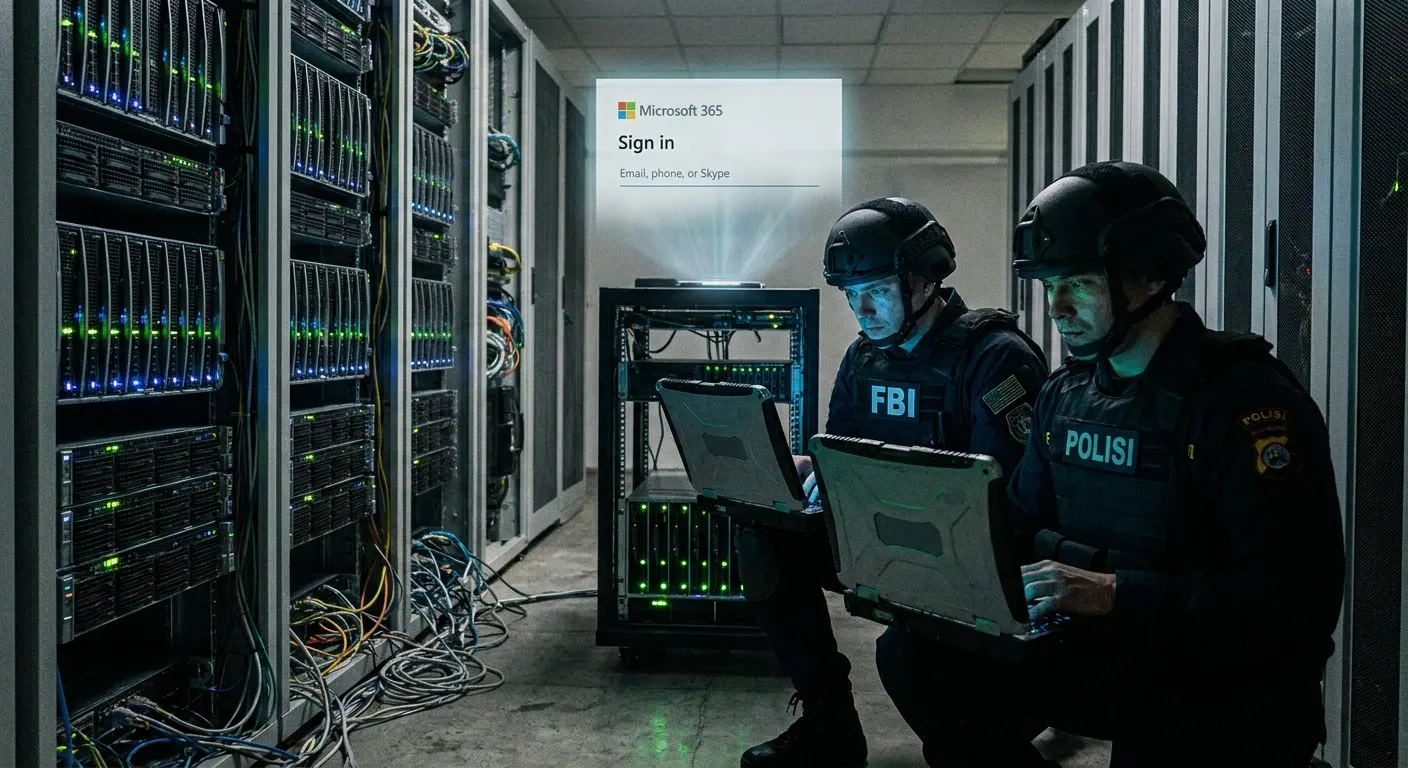
For years, cybercriminals paid $500 to access a toolkit that could crack Microsoft 365 accounts protected by multi-factor authentication. This week, the operation behind it was dismantled.
On April 13, 2026, the FBI announced — alongside the Indonesian National Police — the takedown of the W3LL phishing network: a sophisticated phishing-as-a-service (PhaaS) platform that for years provided criminals with everything needed to steal corporate email accounts, bypass two-factor authentication, and conduct business email compromise (BEC) attacks at scale.
The alleged developer, identified as G.L., an Indonesian national, has been detained. Key domains linked to the scheme have been seized.
What Was W3LL?
W3LL wasn’t a simple phishing kit. It was a full-service criminal platform — sometimes described as “cybercrime-as-a-subscription” — that gave paying customers a complete infrastructure for launching sophisticated email account takeover attacks.
For approximately $500 per license, subscribers received:
- The W3LL Panel: a custom-built phishing page generator that could impersonate Microsoft 365 login pages with near-perfect fidelity
- Attacker-in-the-Middle (AiTM) capability: the feature that made W3LL genuinely dangerous
- Session cookie hijacker: automatically capturing authentication tokens after login
- Credential validator: real-time checking of stolen usernames and passwords
- Campaign management dashboard: tracking which victims had clicked, which had logged in, and which accounts were “ready”
- Underground marketplace access: where criminals could buy and sell stolen credentials and hacked account access
The platform also offered customer support, update notifications, and a private community — marketed through encrypted messaging apps after the main storefront shut down in 2023.
The Feature That Made W3LL Terrifying: Bypassing MFA
Multi-factor authentication is supposed to stop exactly this kind of attack. Even if a criminal steals your password, the second factor — a text code, authenticator app, or hardware key — should block access.
W3LL’s AiTM (Attacker-in-the-Middle) technique defeated this protection.
Here’s how it worked:
- Victim receives a phishing email with a link to what looks exactly like their company’s Microsoft 365 login page
- Victim enters their username and password — which W3LL captures in real time
- W3LL immediately relays those credentials to the real Microsoft servers, acting as a transparent proxy
- Microsoft responds with the MFA challenge — victim receives the actual verification code on their phone
- Victim enters the code on the fake page — W3LL captures it and relays it to Microsoft
- Microsoft completes authentication and issues a session cookie
- W3LL steals that session cookie — which represents a fully authenticated, MFA-verified session
The criminal now has a valid session token. They can access the victim’s email, calendar, OneDrive, and connected business applications — without ever knowing the victim’s password or MFA code, and without triggering any additional authentication challenges.
This is why AiTM phishing has become the preferred technique for sophisticated BEC attacks. The session cookie is often valid for hours or days, giving attackers ample time to read emails, identify payment processes, impersonate executives, and redirect wire transfers.
The Scale of the Damage
From 2023 to 2024 alone, W3LL was used to:
- Target more than 17,000 victims worldwide
- Attempt more than $20 million in fraud
- Compromise and sell more than 25,000 Microsoft 365 accounts
- Facilitate the sale of stolen credentials through the W3LL underground marketplace
The majority of attacks targeted businesses — specifically corporate email accounts that could be exploited for BEC fraud. A compromised CFO’s email account is worth far more than a personal Gmail account; it gives attackers the ability to impersonate finance executives, approve wire transfers, and redirect payroll deposits.
Why Phishing-as-a-Service Is So Dangerous
W3LL’s business model represents the industrialization of cybercrime. A criminal who knows nothing about building phishing infrastructure could subscribe to W3LL, receive a turnkey toolkit, and start conducting sophisticated, MFA-bypassing attacks within hours.
This is exactly how the broader cybercrime economy operates today: specialists build the tools, generalists deploy them. The result is that attack techniques which once required deep technical expertise are now accessible to anyone with $500 and a criminal intent.
The FBI’s action against W3LL targets the supply side of this market — the toolmaker, not just the individual attackers. Disrupting the infrastructure affects dozens or hundreds of active campaigns simultaneously.
What Businesses Need to Know Right Now
The W3LL takedown is significant, but the AiTM technique it pioneered is now widely replicated across dozens of other phishing toolkits. Knowing W3LL is gone doesn’t mean your organization is safe from this attack vector.
Upgrade your MFA. Not all MFA is equal against AiTM attacks. SMS codes and authenticator apps can be bypassed by session hijacking. FIDO2 hardware keys (like YubiKey) and passkeys are the only MFA methods that are cryptographically resistant to AiTM phishing — because the authentication is tied to the specific domain, not just the session.
Deploy phishing-resistant conditional access policies. Microsoft Entra ID (formerly Azure AD) supports policies that require phishing-resistant authentication credentials. For any account with financial authority or access to sensitive data, this should be mandatory.
Monitor for anomalous session behavior. Impossible travel alerts, logins from new devices or locations, and access to unusual resources after login are all red flags that a session cookie has been stolen. Invest in email security solutions that detect these patterns.
Train employees on the specific tell. The W3LL page was nearly pixel-perfect — but the URL was always different. Train employees to check the full URL before entering credentials on any Microsoft, Google, or corporate login page. When in doubt, navigate directly to the portal rather than clicking links.
Verify wire transfer requests out-of-band. No matter how legitimate the email looks, any request to change payment details or authorize a new wire transfer must be confirmed via a phone call to a number already on file — never a number provided in the email.
The Arrest and What Comes Next
The arrest of the alleged W3LL developer in Indonesia is a rare win: infrastructure takedowns are common, but developer arrests are not. International coordination between the FBI Atlanta field office and the Indonesian National Police made the arrest possible.
Prosecutors are expected to pursue charges including wire fraud, computer fraud, and conspiracy. The W3LL underground marketplace’s subscriber database — seized as part of the operation — may lead to additional arrests of criminals who used the toolkit.
The dismantling of W3LL is a significant law enforcement victory — but it’s also a reminder that the threat it represents isn’t gone. The AiTM technique is now a standard part of the cybercriminal playbook, embedded in multiple competing toolkits. The only durable protection is upgrading to phishing-resistant authentication before your organization becomes the next victim.
If you suspect your Microsoft 365 account was compromised by a phishing attack, report it to the FBI IC3 at ic3.gov and contact your Microsoft tenant administrator immediately to review sign-in logs and active sessions.