Angela Lipps was babysitting four children at her Tennessee home on July 14, 2025, when a team of US Marshals arrived at her door with guns drawn.
They arrested her as a fugitive from justice. The charge: bank fraud in Fargo, North Dakota — a state the 50-year-old grandmother had never visited, never had any connection to, and couldn’t have even pointed out on a map with confidence.
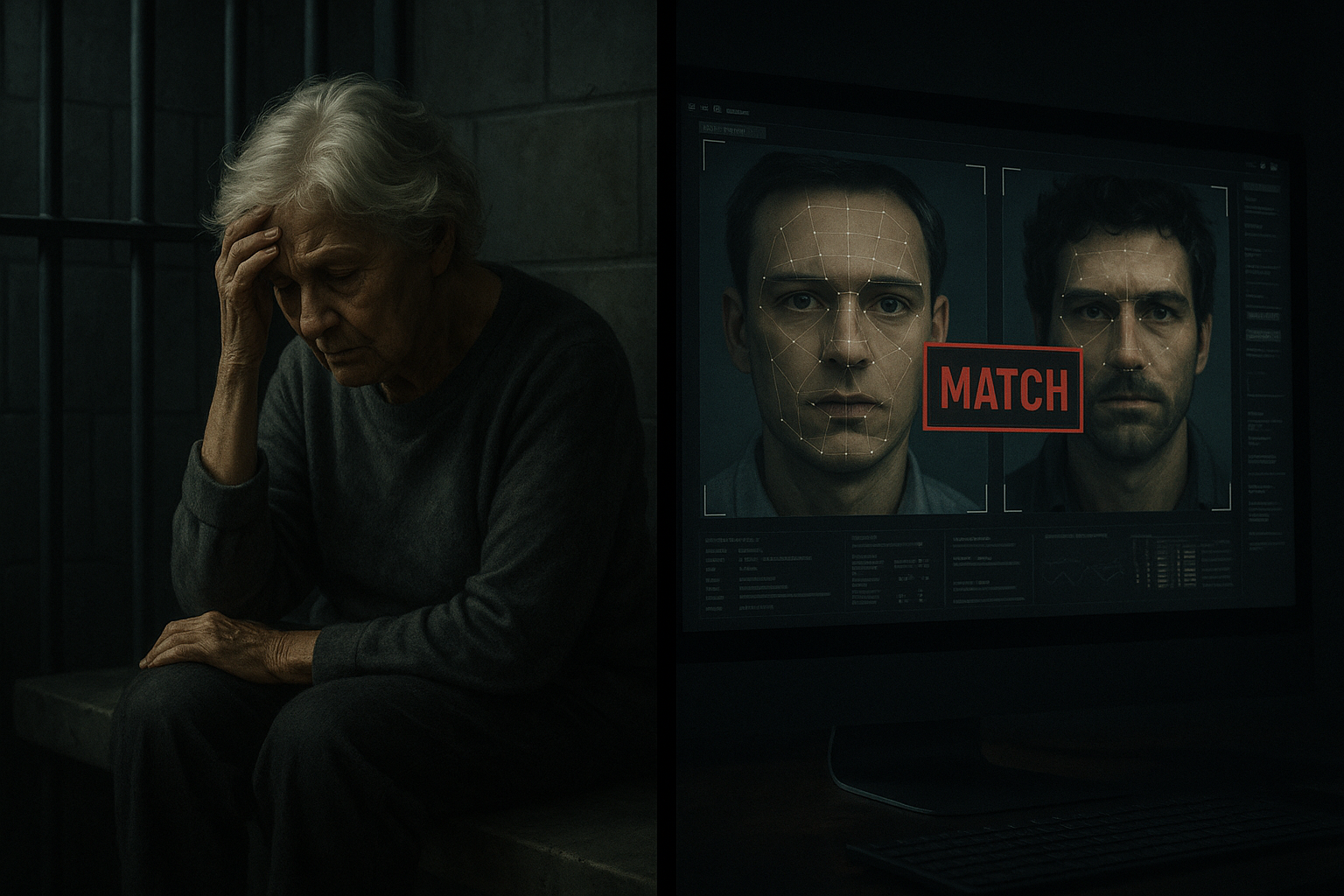
Her crime, according to Fargo police? An artificial intelligence facial recognition system said her face matched surveillance footage of a woman using a fake military ID to steal tens of thousands of dollars from banks.
The AI was wrong.
Lipps would spend the next 168 days behind bars — nearly six months — before anyone bothered to check her bank records, which proved she was buying cigarettes, ordering pizza, and depositing Social Security checks in Tennessee at the exact time police claimed she was committing fraud 1,200 miles away in North Dakota.
By the time the case was dismissed on Christmas Eve, she had lost everything.
The Full Timeline of a System Failure
What happened to Angela Lipps wasn’t a single mistake. It was a cascading chain of failures — technological, procedural, and human — that destroyed an innocent woman’s life one decision at a time.
April–May 2025: The Investigation Begins
Fargo police detectives opened an investigation into a series of bank fraud cases. Surveillance video showed a woman using a fake US Army military ID card to withdraw large sums of money from multiple banks. The total amount stolen reached into the tens of thousands of dollars.
To identify the woman in the grainy surveillance footage, detectives turned to AI-powered facial recognition software.
The AI Match
The facial recognition system returned a result: Angela Lipps, a 50-year-old woman living in north-central Tennessee.
According to police records obtained by WDAY News, the lead detective then compared the surveillance footage to Lipps’ social media photos and Tennessee driver’s license. He wrote in his charging document that Lipps “appeared to be the suspect based on facial features, body type, and hairstyle and color.”
That was the extent of the investigation.
No one called Lipps. No one questioned her. No one checked whether she had ever been to North Dakota. No one pulled her financial records to see where she actually was during the fraud incidents.
The detective filed charges: four counts of unauthorized use of personal identifying information and four counts of theft.
July 14, 2025: The Arrest
US Marshals arrived at Lipps’ home in Tennessee while she was watching four children. She was taken away at gunpoint, handcuffed, and booked into her county jail as a fugitive from justice from North Dakota.
“It was so scary, I can still see it in my head, over and over again,” Lipps told WDAY News.
“I’ve never been to North Dakota, I don’t know anyone from North Dakota.”
July–October 2025: 108 Days Without Bail
As an alleged fugitive from another state, Lipps was held without bail. She was given a court-appointed attorney in Tennessee, but only for the extradition process — not to fight the underlying charges. To challenge the accusations, she was told she would have to go to North Dakota.
For 108 days — more than three and a half months — Lipps sat in a Tennessee jail cell waiting for North Dakota authorities to come get her.
During that time:
- Her bills went unpaid. She was a single woman with no one to cover her expenses.
- She lost her home. Without rent payments, she was evicted.
- She lost her car. Without loan payments, it was repossessed.
- She lost her dog. With no one to care for it, the animal was gone.
- She had no hearing, no interview, no opportunity to present evidence. She simply waited.
No one from the Fargo Police Department contacted her during this entire period.
October 30, 2025: Finally Transported
After 108 days, North Dakota officers finally transported Lipps from Tennessee to Fargo. She appeared in a North Dakota courtroom the next day — her first opportunity to face the charges.
She was assigned a local defense attorney, Jay Greenwood.
December 19, 2025: The First (and Only) Interview
Greenwood did something the Fargo police should have done before ever filing charges: he asked Lipps for her bank records.
The records painted an unmistakable picture. At the exact times police claimed Lipps was in Fargo committing bank fraud, her financial records showed her:
- Depositing Social Security checks at her local Tennessee bank
- Buying cigarettes at a gas station near her home
- Ordering pizza
- Using Cash App to buy Uber Eats
She was more than 1,200 miles away from Fargo.
On December 19, five months and five days after her arrest, Fargo police finally sat down with Lipps for an interview — the first time anyone from the department had ever spoken to her directly.
“If the only thing you have is facial recognition, I might want to dig a little deeper,” Greenwood told InForum.
Christmas Eve: Dismissed and Stranded
Five days after the interview, on December 24, the charges were dismissed and Lipps was released from the Cass County Jail.
But Lipps was now stranded in Fargo, North Dakota — in winter — with no money, no coat (she’d been arrested in her summer clothes in July), and no way home.
Fargo police did not pay for her trip home.
“I had my summer clothes on, no coat, it was so cold outside, snow on the ground, scared, I wanted out but I didn’t know what I was going to do, how I was going to get home,” Lipps said.
Local defense attorneys pooled money to pay for a hotel room and food on Christmas Eve and Christmas Day. The day after Christmas, Adam Martin, founder of a local nonprofit called the F5 Project, drove Lipps to Chicago so she could find transportation back to Tennessee.
“I’m just glad it’s over. I’ll never go back to North Dakota,” Lipps said.
March 2026: No Apology
As of the time of this writing, Lipps is back in Tennessee, trying to rebuild a life that was systematically dismantled by a failed AI system and the police department that trusted it blindly.
No one from the Fargo Police Department has apologized.
WDAY News spent more than a week trying to arrange an interview with Fargo Police Chief David Zibolski about the case. He declined. When a reporter raised the issue at Zibolski’s retirement press conference on March 11, 2026, asking “Why did nobody from Fargo Police ever speak with Angela Lipps for the five months she was in jail?” the chief replied:
“Thank you, Matt, for that question, but we are not here to talk about that today.”
The bank fraud case remains open. No arrests have been made. The actual perpetrator is still unidentified.
This Keeps Happening
Angela Lipps is not an isolated case. She joins a growing list of people whose lives have been upended by facial recognition errors — a pattern that civil rights organizations say is far more common than most people realize.
Robert Williams — Detroit, 2020
In the first publicly reported case of facial recognition leading to a wrongful arrest, Robert Williams was handcuffed on his front lawn in front of his wife and young daughters after Detroit police used facial recognition to match him to surveillance footage of a shoplifter. The technology was wrong. Williams, who is Black, was held for 30 hours before the charges were dropped. He later sued the city with the ACLU’s support, resulting in a historic settlement.
Porcha Woodruff — Detroit, 2023
Porcha Woodruff was eight months pregnant when Detroit police arrested her at her home for alleged carjacking and robbery — based on a facial recognition match. She was detained for 11 hours, experienced contractions and dehydration while in custody, and was ultimately released when the evidence fell apart. Like Williams, she was Black. Like Williams, the technology was wrong.
Randal Reid — Louisiana/Georgia, 2022
Randal Reid was arrested in Louisiana for a theft that occurred in a city he’d never visited, based on a facial recognition match from a police department in Jefferson Parish. He spent nearly a week in jail before the warrant was recalled. He was never even in the state where the crime occurred.
UK Burglary Case — 2025
Earlier in 2026, British police arrested a man for a burglary 100 miles away in a city he’d never visited, after automated facial recognition software confused him with another person of South Asian heritage.
Taki Allen — Baltimore, 2025
In October 2025, an AI surveillance system at Kenwood High School in Baltimore mistook a student’s bag of Doritos for a firearm and alerted police. Taki Allen was sitting with friends outside the school when officers approached with weapons drawn, forced him to his knees, handcuffed him, and searched him. They found nothing — because there was nothing to find.
The Pattern Is Clear
Every known wrongful arrest case tied to facial recognition shares the same characteristics:
1. The AI match was treated as conclusive evidence. In Lipps’ case, the detective wrote that she “appeared to match” based on the AI result, then looked at her social media and driver’s license to confirm his bias. This isn’t investigation — it’s confirmation bias dressed up as police work.
2. Basic investigative steps were skipped. No phone call. No interview. No financial records check. No alibi verification. Any of these routine steps would have immediately cleared Lipps. The AI match short-circuited the investigative process.
3. The accused bore the full cost of the system’s failure. Lipps lost her home, car, dog, and nearly six months of her life. She was stranded in a strange city on Christmas Eve. Fargo police didn’t even cover her bus ticket home.
4. There was no accountability. No officer was disciplined. No policy was changed. No apology was issued. The police chief refused to discuss it. The system ground up an innocent person and kept rolling.
5. The technology disproportionately fails. Multiple studies — including research by NIST, the MIT Media Lab, and the ACLU — have documented that facial recognition systems have significantly higher error rates for people of color, women, and older adults.
How to Protect Yourself
The terrifying reality of Angela Lipps’ case is that she did nothing wrong — and there was nothing she could have reasonably done to prevent it. The AI pointed at her, and the system followed its instructions without question.
But there are steps you can take to protect yourself if you ever find yourself in a similar nightmare:
1. Demand to Know the Basis for Your Arrest
If you are arrested based on a warrant from another jurisdiction, ask your attorney to obtain the probable cause affidavit. If facial recognition was the primary basis, your attorney should challenge the warrant immediately.
2. Preserve Your Financial and Location Records
Bank statements, credit card records, phone GPS data, transaction histories — these are your alibi in the digital age. Lipps was cleared by her bank records. Keep your financial records accessible (not just digital — keep backup access information with a trusted family member).
3. Know Your Rights Regarding Extradition
If you’re arrested as a fugitive from another state, you have the right to a hearing on whether you’re the person named in the warrant. An attorney can challenge the identification before extradition.
4. Document Everything
If you’re wrongfully arrested, document every cost, every lost asset, every day of incarceration. This information is critical for any future civil rights lawsuit.
5. Contact the ACLU
The American Civil Liberties Union has been at the forefront of challenging facial recognition abuses. They have represented multiple wrongful arrest victims and can connect you with legal resources.
The Uncomfortable Truth
We are living in an era where an algorithm can look at a grainy surveillance photo, compare it to your driver’s license, and send armed federal agents to your door — without a single human being picking up the phone to ask you a question first.
Angela Lipps’ attorney said it best: “If the only thing you have is facial recognition, I might want to dig a little deeper.”
Fargo police didn’t dig deeper. They didn’t dig at all.
And a grandmother in Tennessee paid for it with her home, her car, her dog, and six months of her life.
The AI got it wrong. But the AI didn’t arrest Angela Lipps. People did. People who chose to trust a machine over basic police work. People who had 168 days to pick up a phone and check, and never did.
That’s not a technology problem. That’s a human one.
The bank fraud case in Fargo remains open and under investigation. Anyone with information can contact the Fargo Police Department. Angela Lipps has not announced any legal action against the department, but civil rights attorneys say cases like hers often result in federal lawsuits under 42 U.S.C. § 1983 for violation of civil rights.