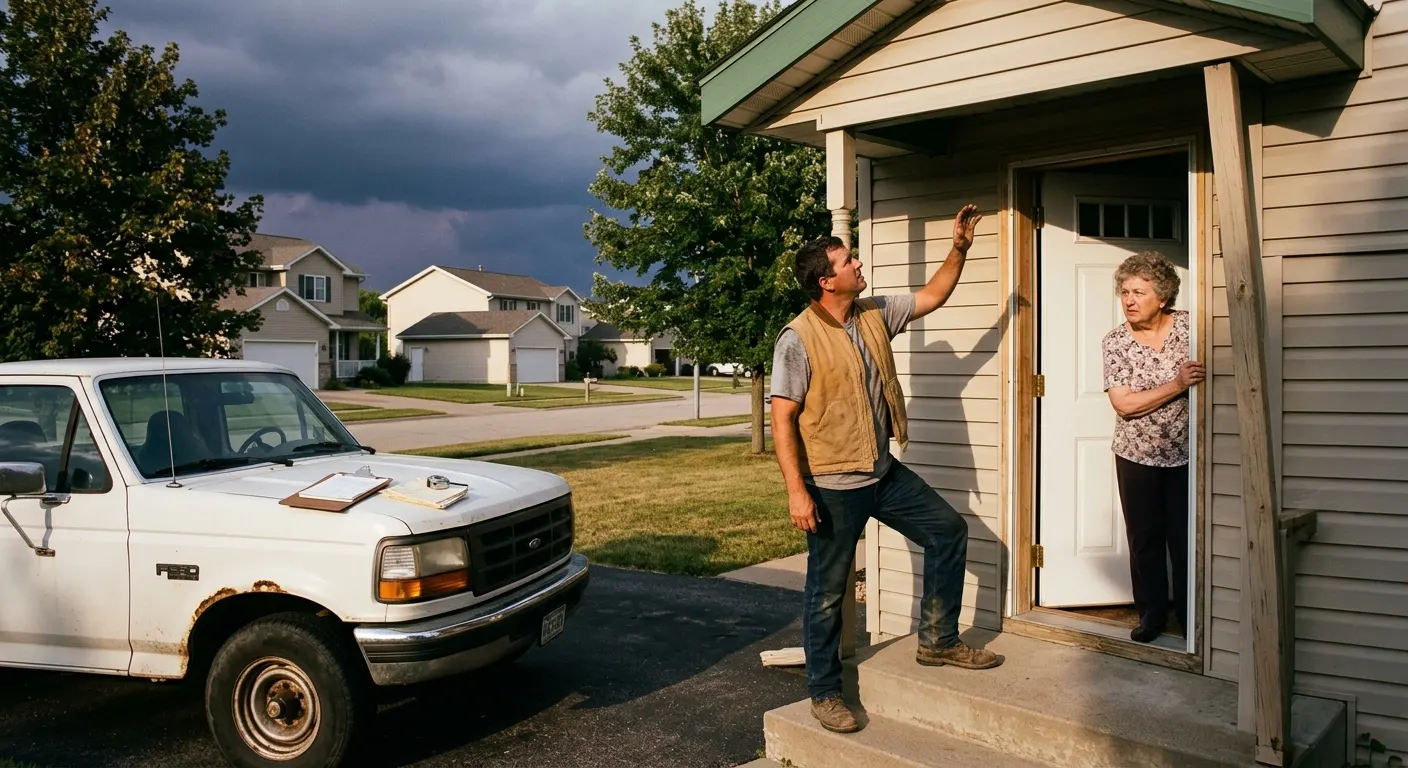
The Season Is the Scam
Home improvement fraud has a calendar, and August sits at the top of it. Warm weather brings roofing, driveway, siding, and remodelling work; remodelling work brings contractors to the door; and a share of those contractors are not contractors.
The scale is easy to underestimate because the individual losses look survivable. In the most recent full year of Better Business Bureau data, U.S. consumers filed 81,925 home improvement scam reports with a median loss of $1,800 — the fourth-costliest of 27 tracked scam categories. The BBB also estimates that nearly one in ten Americans has experienced a home improvement scam.
One in ten. That is a higher exposure rate than romance fraud, investment fraud, or any of the categories that dominate headlines. Home improvement fraud is the most common significant scam in American life, and it gets a fraction of the attention, largely because it does not involve crypto or artificial intelligence — it involves a truck, a clipboard, and a handshake.
The $250,000 Case
The median tells you about frequency. It tells you nothing about the ceiling.
In North Texas, a family lost $250,000 to a couple who presented themselves as architects and remodellers. The pattern that followed is the same one that appears in nearly every large contractor fraud: the money went out, work did not begin promptly, and the contractors became progressively harder to reach.
That sequence — pay, delay, vanish — is the entire mechanism. It works at $250,000 for the same reason it works at $1,800: home renovation legitimately involves large upfront costs for materials and permits, so a substantial early payment does not feel like a red flag. It feels like how construction works.
The difference between a real contractor asking for a deposit and a fraudster asking for a deposit is not the request. It is everything that can be verified around it.
The Five Recurring Playbooks
The storm chaser. Crews arrive in a neighbourhood within days of hail, wind, or flooding, often from out of state, offering immediate roof or siding repair. They frequently offer to “handle the insurance claim” and sometimes to waive the deductible — the latter being insurance fraud that exposes the homeowner, not just the contractor. Work is substandard or never completed, and the company is unreachable by the time the next storm season arrives.
The door-knock urgency pitch. An unsolicited visitor reports a problem you cannot see — damaged shingles, a failing chimney, a driveway that needs sealing — and happens to have leftover material from a nearby job at a discount available today only. Legitimate contractors do not have surplus materials they need to offload before sundown.
The escalating deposit. The initial quote is reasonable. Once demolition starts, the contractor discovers rot, asbestos, code violations, or foundation problems requiring immediate additional payment. Each discovery is timed for the moment your home is least usable and you are least able to walk away.
The permit dodge. The contractor asks the homeowner to pull the permit, or suggests skipping it to save money. Both should end the conversation. A homeowner-pulled permit shifts liability for defective work onto the homeowner, and unpermitted work can block a future sale, void insurance, and force expensive remediation.
The disappearing deposit. The simplest version and still the most common: a large upfront payment, usually demanded in cash, by wire, or increasingly by peer-to-peer app, and then nothing. Payment method is the tell. A contractor who cannot accept a cheque or a credit card is choosing irreversibility.
Why This Category Is Harder Than It Looks
Most scam advice reduces to “verify independently.” Home improvement resists that in ways worth naming honestly.
The work is genuinely urgent. A leaking roof does not wait for three quotes. Storm-chasing crews exist precisely because the aftermath of severe weather produces thousands of homeowners who need work done now and whose regular contractors are booked for months.
Licensing is inconsistent. Requirements vary by state, county, and trade, and a licence number on a business card means nothing until it is checked against the issuing authority — which most homeowners never do.
And the relationship is physical. A person is standing on your property, being friendly and competent-sounding. Declining feels rude in a way that hanging up on a robocall does not. That social pressure is the actual product being sold at the door.
Protecting Yourself
Never hire from an unsolicited knock or call. This one rule eliminates the majority of the category. If someone arrives uninvited to tell you about damage you had not noticed, thank them and get an independent inspection. Any genuine problem will still be there next week.
Cap the deposit and never pay in full upfront. A reasonable deposit is a third or less; many states cap it by law — in California, for example, at 10% or $1,000, whichever is less. Structure remaining payments against completed, inspected milestones. Never make the final payment until the work passes inspection and you have lien releases from subcontractors and suppliers.
Pay by credit card or cheque. Credit cards carry dispute rights; cash, wire, gift cards, Zelle, Venmo and Cash App carry none. A contractor who insists on an irreversible method is telling you what they expect to happen.
Verify the licence and insurance at the source. Get the licence number and check it directly with your state or county licensing board — not on a website the contractor gives you. Ask for the certificate of insurance and call the insurer to confirm it is active. Uninsured work on your property can leave you liable for injuries.
Insist on a written contract before any money moves. It should specify scope, materials with brands and grades, total price, payment schedule, start and completion dates, warranty terms, and who pulls the permit. Verbal change orders should not exist — every change goes in writing with a price attached.
Pull the permit yourself only if you are the one doing the work. If a contractor asks you to pull it, that is a signal they cannot — because they are unlicensed, or their licence is in trouble.
Check the business’s history, not just its reviews. Look up the company on the BBB, your state attorney general’s consumer complaints database, and court records for judgments. Newly formed entities with no trace before this spring are worth a hard second look — sprawling networks of short-lived LLCs are a hallmark of repeat offenders.
Never let a contractor handle your insurance claim. Deal with your insurer directly. Any offer to “cover” or “waive” your deductible is a proposal to commit insurance fraud with your name on it.
Report it even when the money is gone. File with the BBB Scam Tracker, your state attorney general, your local building department, and ReportFraud.ftc.gov. Contractor fraud is one of the few scam categories where local enforcement is realistic — the perpetrators live nearby, operate under traceable business names, and leave a paper trail of permits and complaints. Reports are how that trail gets connected.
The single most useful habit is the least natural one: treat urgency itself as the warning. Every version of this scam, from the $1,800 driveway to the $250,000 remodel, depends on a decision made faster than a verification could be completed.