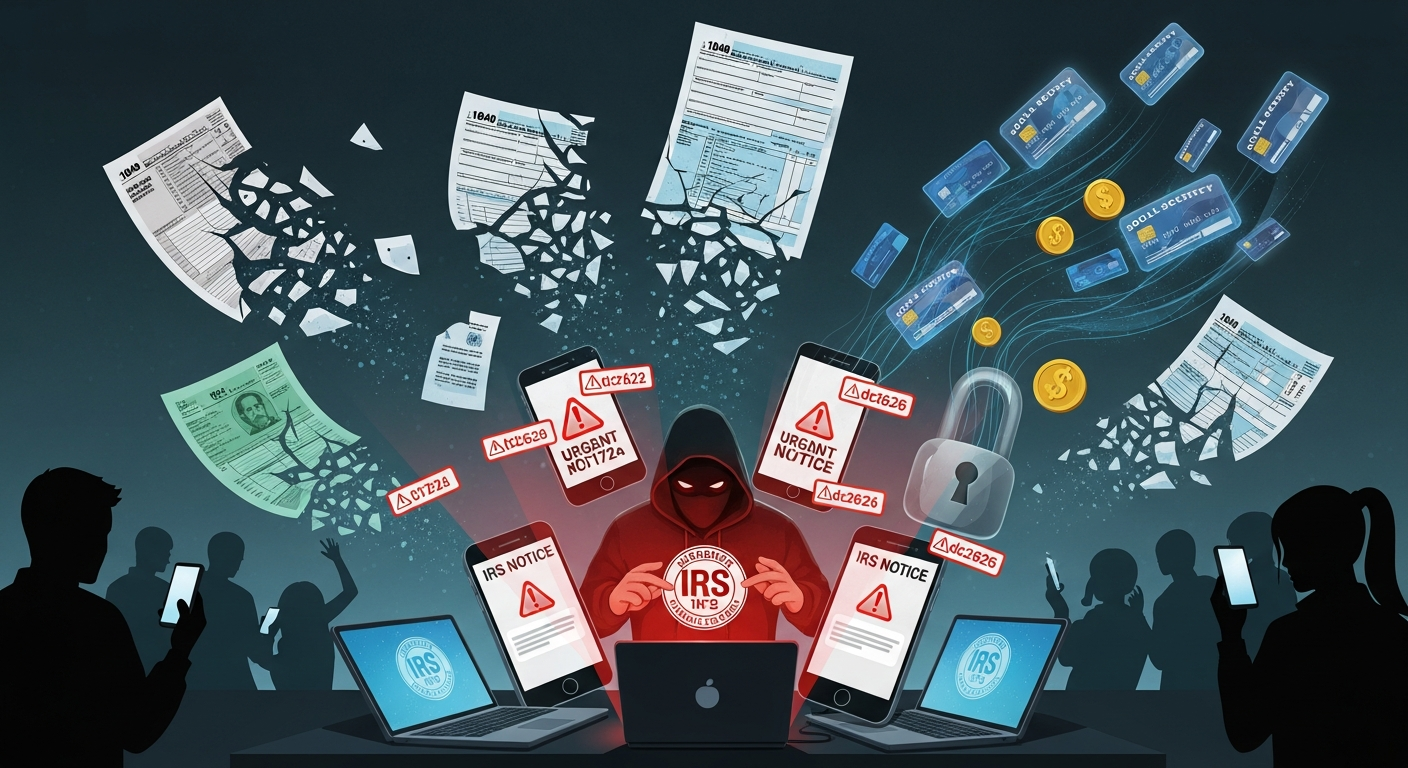
Tax season is here, and so are the scammers. But if you think you’re too smart to fall for an IRS scam, think again. The criminals targeting your tax refund in 2026 aren’t the bumbling con artists of years past—they’re sophisticated operators wielding artificial intelligence, deepfake technology, and psychological manipulation techniques refined over decades of fraud.
Last year alone, Americans lost over $1.3 billion to imposter scams, with IRS and government impersonation schemes leading the pack. This year, the stakes are even higher. Scammers have leveled up, incorporating AI voice cloning, hyper-personalized phishing attacks, and elaborate fake tax preparation services designed to steal not just your refund, but your entire identity.
Here’s what you need to know to protect yourself—and your family—from the five most dangerous tax scams of 2026.
The 2026 IRS “Dirty Dozen” Scam List: What’s Changed
Every year, the IRS publishes its “Dirty Dozen” list of the most prevalent tax scams threatening Americans. For 2026, the agency has highlighted several evolving threats that taxpayers need to watch out for:
Phishing and Smishing Attacks remain at the top, with criminals sending increasingly convincing emails and text messages that impersonate the IRS, tax software companies, and financial institutions. These messages often contain links to fake websites designed to harvest your personal information.
Social Media Scams have exploded, with fraudsters spreading misinformation about fake tax credits and refund schemes on platforms like TikTok, Instagram, and Facebook. Some scammers pose as tax professionals offering “secret” deductions that can get you audited—or worse.
Spearphishing and AI-Generated Attacks target high-value individuals including business owners, tax professionals, and payroll administrators. These attacks are more personalized than ever, using information scraped from LinkedIn, public records, and data breaches.
Ghost Tax Return Preparers continue to prey on vulnerable taxpayers, preparing fraudulent returns that claim fake deductions, then vanishing with their fees—leaving you to face the IRS.
Refund Advance Loan Traps offer quick cash but extract enormous hidden fees, sometimes eating up 30% or more of your expected refund.
The IRS updates this list annually, but scammers evolve faster than any government agency can track. Here are the five specific scams causing the most damage this tax season.
Scam #1: IRS Impersonation 2.0 — Now With AI Voice Cloning
Remember when IRS phone scams were obvious? A robotic voice, a heavy accent that didn’t match the “IRS Agent” name, or a clearly scripted demand for iTunes gift cards? Those days are over.
How the Scam Works
In 2026, criminals are using AI voice cloning technology to create phone calls that sound frighteningly realistic. Using voice synthesis tools trained on recordings of real government officials—or even generic “American accent” voices—scammers can now generate convincing, natural-sounding calls in real-time.
Here’s a typical scenario:
You receive a call. The caller ID shows “Internal Revenue Service” or displays a Washington, D.C. number. A professional-sounding voice introduces themselves as “Agent Michael Torres from the IRS Collections Division.” They know your name, your address, and the last four digits of your Social Security number (likely obtained from one of the countless data breaches affecting millions of Americans).
The “agent” explains that you have an outstanding tax liability from a previous year. Perhaps it’s a missed payment, a mathematical error on your 2024 return, or an unreported 1099. The details sound plausible because they’re designed to. The scammer has done their homework, combining publicly available information with data purchased from dark web markets.
Then comes the pressure: “This matter has been escalated to our enforcement division. If you don’t resolve this debt today, we will be forced to issue an arrest warrant and notify local law enforcement.” Some versions threaten deportation for immigrants, driver’s license suspension, or asset seizure.
The kicker? They’re willing to help you “resolve” the matter right now with a payment. But only if you pay via wire transfer, cryptocurrency, prepaid debit card, or gift cards.
Why AI Voice Cloning Changes Everything
Traditional phone scams had tells. Awkward pauses, unnatural phrasing, robotic cadence. AI voice cloning eliminates these red flags. Modern voice synthesis systems can:
- Generate speech in real-time, responding to your questions naturally- Clone specific voice characteristics from as little as 3-5 seconds of audio- Adjust tone and emotion to sound concerned, authoritative, or friendly as needed- Eliminate foreign accents that previously tipped off victims
Some sophisticated operations even use AI chatbots on the backend, feeding responses to human operators who add authenticity to the call while the AI handles script generation.
How to Protect Yourself
The IRS will NEVER:
- Call you demanding immediate payment- Threaten arrest, deportation, or license revocation over the phone- Demand payment via gift cards, wire transfers, or cryptocurrency- Call without first sending written notice by U.S. mail- Ask for credit or debit card numbers over the phone
What to do if you receive a suspicious call:
- Hang up immediately. Don’t engage, don’t ask questions, just end the call.2. Don’t call back any number they provide. Even if it seems to match a legitimate IRS number, it could route to the scammers.3. If you’re concerned about a genuine tax debt, call the IRS directly at 1-800-829-1040 or visit IRS.gov to check your account.4. Report the scam to the Treasury Inspector General for Tax Administration at TIGTA.gov or call 1-800-366-4484.
Scam #2: Fake Tax Prep Services — Stealing Refunds AND Identities
With tax preparation services costing anywhere from $200 to $600 for a typical return, the promise of cheap (or free) professional tax help is tempting. Scammers know this, and they’ve created an entire ecosystem of fraudulent tax preparation services designed to exploit that demand.
How the Scam Works
Fake tax preparers operate in several ways:
The Pop-Up Office Scam: Around January, storefronts appear in strip malls and shopping centers offering “Professional Tax Preparation — Refunds in 24 Hours!” These operations set up quickly, process returns during the busy season, and vanish by April 15. They charge upfront fees, may inflate your deductions to promise larger refunds, and often file returns that direct refunds to accounts they control.
The Social Media “Expert”: Instagram and TikTok are flooded with accounts promoting “tax hacks” and offering to prepare returns for followers. These unlicensed operators collect your most sensitive personal information—Social Security numbers, W-2s, bank accounts—then use it for identity theft or sell it on dark web marketplaces.
The Refund Theft Scheme: Some fake preparers file accurate returns but manipulate the direct deposit information. Your refund is deposited into their account. By the time you realize the money never arrived, they’ve withdrawn the funds and disappeared.
The Identity Harvesting Operation: The most sophisticated operations don’t even care about your current refund. They’re collecting the complete personal and financial information needed to commit identity theft for years to come—opening credit cards, taking out loans, and filing fraudulent returns in your name.
Warning Signs of a Fake Tax Preparer
- No Preparer Tax Identification Number (PTIN): All paid tax preparers are required by law to have a PTIN issued by the IRS. Ask to see it.- Promises of unusually large refunds before reviewing your actual documents- Fees based on a percentage of your refund rather than the complexity of your return- Cash-only payments with no receipt or contract- Refuses to sign the return or provide their credentials- No physical office or uses only a P.O. Box- Can’t be found in the IRS Directory of Federal Tax Return Preparers
How to Protect Yourself
- Verify credentials. Use the IRS Directory at IRS.treasury.gov to check if a preparer has valid credentials.2. Get a written estimate of fees before sharing any documents.3. Review your return before signing. Ensure the direct deposit account number matches YOUR bank account.4. Keep copies of everything you submit to a preparer.5. Report suspicious preparers to the IRS at IRS.gov/help/tax-scams/recognize-tax-scams-and-fraud.
Scam #3: Ghost Preparer Scams — The Tax Pro Who Won’t Sign
Ghost preparers are tax return preparers who refuse to sign the returns they prepare—a federal violation that’s also a massive red flag for fraud.
How the Scam Works
By law, any paid preparer must sign the tax return and include their Preparer Tax Identification Number (PTIN). Ghost preparers deliberately avoid this requirement for several reasons:
- They’re not legally authorized to prepare returns and don’t have a PTIN- They’re filing fraudulent returns and don’t want a paper trail- They plan to disappear once tax season ends- They’re claiming fake deductions or credits that will trigger IRS scrutiny
Ghost preparers often target vulnerable populations: immigrants, elderly individuals, low-income families, and anyone unfamiliar with the U.S. tax system. They may set up shop in community centers, churches, or neighborhoods where they can exploit trusted relationships.
The Danger to You
When a ghost preparer files a fraudulent return in your name, you’re the one responsible. The IRS will come after you for:
- Repayment of fraudulent refunds with interest and penalties- Civil fraud penalties up to 75% of the underpayment- Criminal prosecution in severe cases
Meanwhile, the ghost preparer has vanished with their fee—and potentially your personal information.
Red Flags of a Ghost Preparer
- Refuses to sign the return or provide a PTIN- Asks you to sign a blank return or one that’s incomplete- Insists on mailing paper returns instead of e-filing (to avoid the digital trail)- Directs your refund to their account with a promise to forward the money- Won’t provide copies of the completed return- Only accepts cash and won’t give receipts
How to Protect Yourself
- Never sign a blank or incomplete return. Review every line before signing.2. Verify the preparer signed the return before it’s filed. Check for their name and PTIN on the form.3. Ensure your bank account is listed for direct deposit, not the preparer’s.4. Request a complete copy of your return for your records.5. Report ghost preparers using IRS Form 14157, “Complaint: Tax Return Preparer.”
Scam #4: Refund Advance Traps — Hidden Fees Eating Your Money
The promise is appealing: get your tax refund now, not in 21 days. Refund Advance Loans (RALs) and similar products offer instant cash against your expected refund. But for many taxpayers, these products turn into financial traps that extract hundreds of dollars in fees.
How the Scam Works
Refund advance products work like short-term loans secured against your expected IRS refund. You receive cash immediately (usually within 24-48 hours of filing), and when your actual refund arrives, it’s directed to the lender to repay the advance.
Sounds reasonable, right? Here’s where it gets predatory:
Excessive Fees: While some mainstream tax preparers offer no-fee or low-fee refund advances, many second-tier operators charge significant fees. A $300 fee on a $3,000 refund advance represents an effective APR of over 300% for a 3-week “loan.”
Mandatory Tax Preparation: To get the advance, you must have your return prepared by that company. Many charge inflated preparation fees—sometimes $400-$600 for simple returns that should cost under $200.
Add-On Products: “Audit protection,” “identity theft insurance,” and “refund guarantee” products are tacked on, sometimes automatically. These may add another $50-$150 to your costs.
Bank Account Requirements: Some advances require you to open a prepaid debit card or bank account through a partner financial institution, generating more fees for ATM withdrawals, monthly maintenance, and balance inquiries.
Targeting the Desperate: These products disproportionately target low-income families who most need their refunds quickly—and can least afford to lose hundreds of dollars to fees.
The Real Cost
Consider this example:
- Expected refund: $4,000 (including Earned Income Tax Credit)- Refund advance: $3,500 (lenders cap advances below full refund amount)- Tax preparation fee: $399- Refund advance fee: $150- “Refund Transfer” fee: $50- Prepaid card activation: $25- Total extracted: $624- Actual money received: $3,376
That’s 15.6% of the refund gone to fees—money that low-income families desperately need.
How to Protect Yourself
- Ask the total cost in writing before agreeing to any service. Demand itemized fees.2. Compare e-file options. IRS Free File allows qualified taxpayers (income under $84,000 in 2025) to file for free. Refunds via direct deposit typically arrive in 21 days.3. Avoid “refund transfer products” unless you have no bank account. These add fees for temporary bank accounts.4. Don’t pay with your refund if you can pay upfront. Financing prep fees through your refund always costs more.5. Use VITA or TCE. The Volunteer Income Tax Assistance and Tax Counseling for the Elderly programs offer free tax preparation for qualifying individuals.
Scam #5: W-2/1099 Phishing — Targeting Employers for Your Data
While most tax scams target individual taxpayers, one of the most devastating schemes targets employers—specifically, anyone with access to employee payroll data.
How the Scam Works
The W-2 phishing scam (sometimes called the “BEC W-2 scam” for Business Email Compromise) works like this:
- Reconnaissance: Scammers research a target organization, identifying HR personnel, payroll administrators, and executives. LinkedIn, company websites, and press releases provide a wealth of information.2. Impersonation Email: A payroll or HR employee receives an urgent email appearing to come from the CEO, CFO, or another executive. The email address may be spoofed to match the real executive’s, or may use a nearly identical domain (like company-ceo.com instead of company.com).3. The Request: The “executive” urgently requests a list of all employee W-2 forms, or all 2025 earnings and tax withholding information. They may cite an audit, an insurance requirement, or a need to verify payroll information.4. The Data Dump: The unsuspecting employee compiles the information and sends it—often as an Excel file containing names, addresses, Social Security numbers, dates of birth, and income information for every employee.5. The Aftermath: Within hours, fraudulent tax returns are filed for every employee on the list. By the time employees attempt to file their legitimate returns, they discover their refunds have already been claimed.
The Massive Scale of This Scam
A single successful W-2 phishing attack can compromise hundreds or thousands of identities simultaneously. Major organizations affected in recent years include:
- School districts compromising thousands of teachers and staff- Healthcare systems exposing patient-facing employees- Nonprofit organizations with limited IT security- Small businesses with informal communication practices
The IRS has issued repeated warnings about this scheme, but it continues to claim victims every tax season.
Who’s at Risk
If your employer experiences a W-2 phishing attack, you may face:
- Fraudulent tax returns filed in your name- IRS rejection of your legitimate return- Delayed refunds (sometimes by 6-12 months or more)- Long-term identity theft using your compromised information- Need to file IRS Form 14039 (Identity Theft Affidavit)
How Employers Can Protect Employees
- Implement verification protocols. Any request for bulk employee data must be verified via phone call using a known number—not a number in the email.2. Train HR and payroll staff to recognize phishing attempts.3. Use email authentication (DMARC, SPF, DKIM) to prevent email spoofing.4. Limit who has access to bulk payroll data.5. Report incidents immediately to [email protected] and local FBI field office.
What Employees Can Do
- Ask your employer about their data security practices and phishing training.2. File early. Submitting your return before scammers do means you’ll get your refund (they won’t).3. Monitor IRS.gov. Create an account at IRS.gov to view your tax transcripts and catch unauthorized filings.4. Consider an Identity Protection PIN. The IRS IP PIN program adds a layer of protection against fraudulent filings.
How to Verify IRS Contact Is Real
The IRS has clear protocols for contacting taxpayers. Understanding these can help you instantly identify scams:
Legitimate IRS Contact
- Almost always by mail first. The IRS initiates most contacts through letters delivered by the U.S. Postal Service.- Multiple notices before action. Before any enforcement action, you’ll receive several written notices.- In-person visits may occur for audits, overdue bills, or criminal investigations—but only after written notices and typically with prior appointment.- IRS employees carry two forms of ID: A pocket commission and an HSPD-12 card. You have the right to verify credentials by calling a dedicated IRS number.- Private debt collectors are used for some debts, but only after two letters: one from the IRS, then one from the collector. They will never demand phone payment.
What the IRS Will NEVER Do
This list is your cheat sheet for identifying scams. The IRS will NEVER:
- Call to demand immediate payment using a specific payment method- Demand payment without opportunity to question or appeal- Threaten to bring in law enforcement for immediate arrest- Demand gift cards, wire transfers, cryptocurrency, or payment apps- Ask for credit or debit card numbers over the phone- Threaten to revoke your driver’s license, business license, or immigration status- Email, text, or contact you via social media to demand money or personal information- Leave pre-recorded “urgent” voicemails threatening legal action
How to Report Tax Scams
If you encounter a tax scam, reporting it helps protect others:
For IRS Impersonation Phone Scams:
- Treasury Inspector General for Tax Administration: TIGTA.gov or 1-800-366-4484- Federal Trade Commission: ReportFraud.ftc.gov (add “IRS Telephone Scam” in notes)
For Phishing Emails or Websites:
- Forward suspicious emails to: [email protected] Don’t click links or open attachments—just forward and delete
For Tax Preparer Fraud:
- File IRS Form 14157: “Complaint: Tax Return Preparer”- Report to your state attorney general’s office- Contact local law enforcement if you’ve lost money
For Identity Theft:
- File IRS Form 14039: Identity Theft Affidavit- Visit IdentityTheft.gov for a complete recovery plan- Consider placing a fraud alert or credit freeze with credit bureaus
Protecting Elderly Relatives From Tax Scams
Seniors are disproportionately targeted by tax scams. If you have elderly parents, grandparents, or neighbors, here’s how to help protect them:
Why Seniors Are Targeted
- More likely to answer unknown calls from landlines- May be less familiar with digital scam tactics- Often have savings that scammers want to access- May be more trusting of authority figures- Less likely to report being victimized due to embarrassment
Protective Steps
- Have the conversation. Explain that the IRS will never call demanding immediate payment. Role-play scenarios so they know what to do.2. Set up call screening. Use call-blocking apps or carrier services to filter robocalls and unknown numbers.3. Offer to help with taxes. If possible, assist with tax preparation or be present when they work with a preparer.4. Create a verification system. Establish a family code word—if anyone calls claiming to be from the IRS or demanding money, they should call you first to verify.5. Monitor their mail. Watch for unexpected IRS notices or signs they may have responded to a scam (strange bank withdrawals, gift card purchases).6. Register for the IRS IP PIN. The Identity Protection PIN adds a security layer that prevents fraudulent return filing.7. Don’t shame victims. If an elderly relative does fall for a scam, react with compassion, not judgment. Shame keeps victims silent and prevents recovery.
Conclusion: Stay Vigilant This Tax Season
The 2026 tax season brings refunds, but it also brings risk. Scammers have never been more sophisticated, and their techniques—from AI voice cloning to elaborate fake tax preparation schemes—are designed to fool even skeptical, educated individuals.
Your best defenses are knowledge and skepticism. Remember: the IRS will never call you out of the blue demanding immediate payment. Legitimate tax preparers have credentials you can verify. And if something feels wrong, it probably is.
File early, protect your information, and help spread the word to friends and family who may be vulnerable. Together, we can make this tax season a little safer.
If you’ve been targeted by a tax scam, don’t be embarrassed—report it. Your report could prevent someone else from becoming a victim.
Report IRS impersonation scams: TIGTA.gov | 1-800-366-4484 Report fraud: ReportFraud.ftc.gov Report phishing: [email protected]
For more information on protecting yourself from scams, visit ScamWatchHQ.com and subscribe to our alerts.