On March 16, 2026, in a conference hall in Vienna packed with over 1,300 delegates from more than 100 countries, INTERPOL Secretary General Valdecy Urquiza made an announcement that sent a clear message to scam compound operators worldwide: the era of operating with impunity is ending.
The operation is called Shadow Storm. And unlike the dozens of anti-fraud operations that came before it, this one isn’t designed to rack up arrest numbers or seize a few hundred million dollars in stolen assets. It’s designed to dismantle the entire infrastructure — the bank accounts, the crypto wallets, the communication channels, the recruitment pipelines, and the criminal leadership that has, until now, remained largely untouchable behind layers of intermediaries and shell companies.
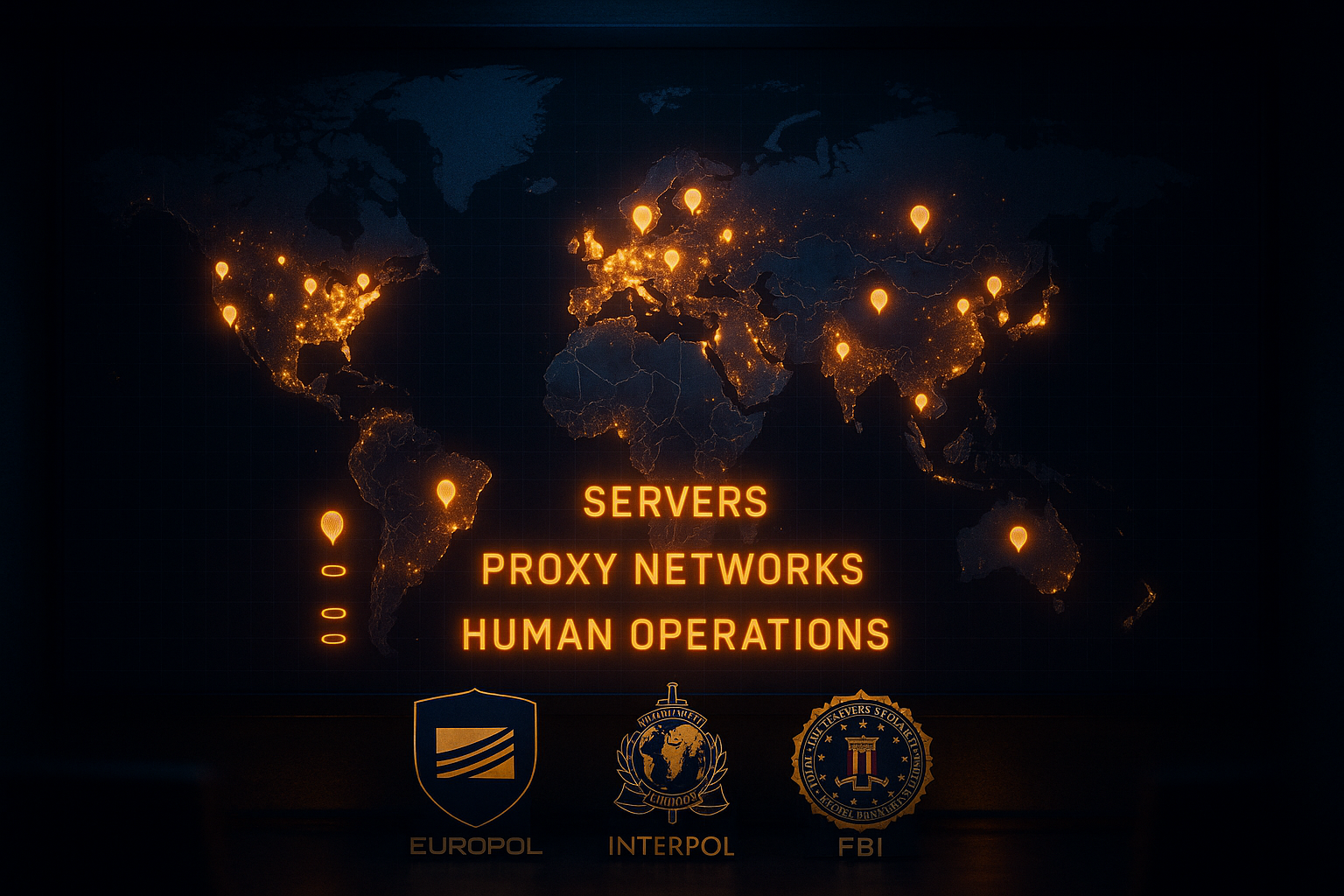
Launched at the inaugural Global Fraud Summit — jointly hosted by INTERPOL and the United Nations Office on Drugs and Crime (UNODC) — Operation Shadow Storm represents the most coordinated international effort ever assembled against the scam compound phenomenon. Funded by the United Kingdom’s Home Office and jointly developed with INTERPOL, the task force will harness the intelligence capabilities of all 196 INTERPOL member countries in a unified, data-driven campaign.
Its initial target: Southeast Asia, the epicentre of a criminal industry that, according to INTERPOL’s own 2026 fraud assessment, drained $442 billion from the global economy in 2025 alone.
Why Shadow Storm Is Different
If you’ve followed INTERPOL’s anti-fraud operations over the past several years, you might reasonably ask: what makes this one different? After all, the agency has run a series of increasingly large operations — HAECHI, First Light, Sentinel, Synergia — each producing impressive headlines. Operation HAECHI V in late 2024 resulted in 5,500 arrests across 40 countries and seized over $400 million. Operation First Light 2024 netted 3,950 suspects and $257 million across 61 countries. Earlier this year, Operation Synergia II led to 94 arrests and the takedown of 45,000 malicious IP addresses.
These operations were significant. They demonstrated growing international willingness to cooperate on financial crime. But they shared a common limitation: they were time-bound enforcement sweeps — coordinated bursts of activity lasting weeks or months, focused primarily on arresting frontline fraudsters and seizing the proceeds of their crimes.
The kingpins walked free. The compounds reopened. New victims were trafficked in to replace the old ones.
Shadow Storm is built on a fundamentally different model. Rather than a time-limited operation, it’s a permanent task force — a standing unit within INTERPOL’s architecture that will continuously collect, correlate, and act on intelligence. And rather than targeting just the fraud itself, it explicitly targets the convergence of criminal enterprises that make scam compounds possible:
- Financial fraud — the scams themselves (pig butchering, romance fraud, crypto investment schemes, sextortion)
- Human trafficking — the forced labour pipeline that supplies workers to the compounds
- Cybercrime — the technical infrastructure, from spoofed communication channels to AI-generated deepfakes
- Money laundering — the crypto mixers, mule account networks, and shell companies that move illicit profits
- Terror finance — the increasingly documented links between fraud proceeds and terrorist group funding, particularly in parts of Africa
This convergence approach — what INTERPOL’s 2026 fraud assessment calls “polycriminality” — is the key innovation. Previous operations treated these as separate crime types investigated by separate teams. Shadow Storm treats them as facets of a single criminal ecosystem and attacks them simultaneously.
The Operational Playbook
INTERPOL hasn’t published a detailed tactical breakdown of Shadow Storm’s methodology — and for operational security reasons, they wouldn’t. But based on statements from INTERPOL officials, the UK Home Office, and the National Crime Agency (NCA), the task force’s approach follows a clear four-phase pattern:
Phase 1: Intelligence Mapping
Shadow Storm investigators will aggregate data from all 196 INTERPOL member countries to build comprehensive maps of scam compound networks. This means pooling intelligence on:
- Bank accounts used to receive and move stolen funds
- Cryptocurrency wallets associated with laundering operations
- Phone numbers used in scam communications
- Social media profiles used for victim recruitment and romance scams
- Corporate registrations and shell companies linked to compound operators
The goal is to move beyond identifying individual fraudsters and instead map the entire financial and communications infrastructure that supports a compound’s operations. Who owns the building? Who supplies the internet connectivity? Which banks process the transactions? Which crypto exchanges facilitate the laundering? Which recruitment networks lure trafficking victims?
Phase 2: Financial Chokepoints
Once the infrastructure is mapped, the task force will move to cut off the money. This is where INTERPOL’s I-GRIP (Global Rapid Intervention of Payments) mechanism becomes critical.
Launched in 2022, I-GRIP is essentially a real-time stop-payment system that enables INTERPOL member countries to trace, intercept, and freeze criminal proceeds across borders. Since its launch, I-GRIP has been used to intercept hundreds of millions of dollars. In one notable case, it helped recover $42 million from a single business email compromise scheme. During a 2025 operation, $439 million was recovered using the mechanism.
For Shadow Storm, I-GRIP will be deployed not just reactively — to freeze funds after a victim reports a scam — but proactively, to choke off the financial lifelines of identified compound operations before coordinated raids take place.
The crypto dimension adds complexity. Scam compounds increasingly convert stolen funds into cryptocurrency, run them through mixing services or privacy coins, and re-enter the traditional banking system through exchanges in jurisdictions with weak KYC (Know Your Customer) requirements. Shadow Storm’s explicit inclusion of crypto wallet tracking suggests INTERPOL will be working closely with blockchain analytics firms — potentially including Chainalysis, which was listed among the private sector partners at the Global Fraud Summit.
Phase 3: Communications Disruption
Before a compound can be physically raided, its ability to communicate with victims, move money, and coordinate with allied criminal networks needs to be severed. This means:
- Shutting down phone numbers and SIM cards used in scam operations
- Suspending social media accounts used for victim targeting
- Disabling messaging platforms and VPN services used for internal coordination
- Taking down websites and domains associated with fraudulent investment platforms
The first-of-its-kind Global Public-Private Partnership signed at the Vienna summit is designed to facilitate exactly this. Signatories — including Meta, Google, Amazon, Match Group, and VMO2 Media — have pledged to share intelligence with law enforcement and coordinate to disrupt scam operations before they reach victims. G7 countries plus Singapore, South Korea, and Japan also signed on.
This is significant because scam compounds are heavily dependent on legitimate tech platforms. Romance scams begin on dating apps. Pig butchering operations recruit victims through WhatsApp, Telegram, and social media. Fake investment platforms are hosted on commercial infrastructure. Cutting these connections doesn’t just slow the scammers — it can make operations economically unviable.
Phase 4: Coordinated Takedowns
With the financial arteries severed and communications disrupted, law enforcement agencies move in for physical raids — ideally simultaneous across multiple jurisdictions to prevent criminal leadership from fleeing or relocating operations.
This is the phase where Shadow Storm’s standing task force model offers the biggest advantage over time-limited operations. Because the intelligence gathering and financial disruption are continuous, the task force can time its physical operations for maximum impact rather than being constrained by an arbitrary operational window.
The Scale of What Shadow Storm Is Up Against
To understand why an operation of this magnitude is necessary, you have to grasp the sheer scale of the scam compound industry — and how rapidly it has metastasized.
The Numbers
According to INTERPOL’s 2026 Global Financial Fraud Threat Assessment:
- $442 billion was lost to financial fraud globally in 2025
- AI-enhanced fraud is 4.5 times more profitable than traditional methods
- The overall global risk of financial fraud remains “high” heading into 2026
- Fraud-related INTERPOL Notices and Diffusions have increased by 54% since 2024
- INTERPOL has supported member countries in more than 1,500 transnational fraud cases since 2024, involving lost assets valued at $1.1 billion
The scam compound industry specifically is estimated to generate $64 billion in annual revenue globally, with the Mekong region alone accounting for over $43.8 billion of that figure, according to UN estimates.
The Human Cost
The financial numbers, as staggering as they are, don’t capture the full horror.
A February 2026 report from the UN Office of the High Commissioner for Human Rights (OHCHR), titled “A Wicked Problem,” provided the most detailed accounting yet of conditions inside scam compounds. Based on interviews with survivors from Bangladesh, China, India, Myanmar, Sri Lanka, South Africa, Thailand, Vietnam, and Zimbabwe who had been trafficked into compounds in Cambodia, Laos, Myanmar, the Philippines, and the United Arab Emirates between 2021 and 2025, the report described:
- At least 300,000 people forced to work in scam compounds across Southeast Asia
- Victims from at least 66 countries, with 74% of known trafficking victims brought to Southeast Asia
- Compounds spanning more than 500 acres, resembling “self-contained towns” surrounded by barbed wire and armed guards
- Confiscated passports, constant surveillance, and punishment by torture for failing to meet scamming quotas
- “Water prisons,” confinement in complete darkness for days, and sleep deprivation of up to 19 hours of forced work per day
- Rape, forced prostitution, and forced abortions — with sexual violence reportedly increasing since 2024
- Workers forced to watch or participate in beatings of fellow captives
- Multiple reports of deaths within compounds
“The treatment endured by individuals within the context of scam operations is alarming,” the OHCHR report stated. “Morning assemblies often included low-performing teams being publicly subjected to torture as a warning to others.”
UN High Commissioner for Human Rights Volker Türk put it bluntly: “The litany of abuse is staggering and at the same time heart-breaking. Yet, rather than receiving protection, care and rehabilitation, victims too often face disbelief, stigmatization and even further punishment.”
A February 2025 operation along the Thailand-Myanmar border freed some 7,000 people from compounds — but observers warned that many crackdowns are ad hoc, and compounds frequently resume operations shortly after raids.
The Geographic Spread
What began as a problem concentrated in Myanmar, Cambodia, and Laos has gone global. INTERPOL’s 2025 and 2026 assessments document scam centres expanding into:
- Central and South America
- North Africa
- The Middle East
- West Africa — where INTERPOL’s Operation Sentinel led to mass arrests in Benin
- Parts of Europe
In each of these regions, the same pattern holds: people are trafficked under false pretences, detained in guarded facilities, and forced to perpetrate online fraud. The operational model is being franchised, with Southeast Asian criminal syndicates exporting their playbook to new territories where law enforcement capacity is weaker and corruption more entrenched.
The AI Accelerant
Shadow Storm launches at a moment when artificial intelligence is fundamentally changing the economics of fraud.
INTERPOL’s 2026 assessment found that AI-enhanced scams are 4.5 times more profitable than their traditional counterparts. The reasons are straightforward:
Deepfakes have gotten terrifyingly good. Criminals can now create convincing voice clones with just ten seconds of reference audio — easily ripped from a social media post or voicemail greeting. Dark web marketplaces offer “deepfake-as-a-service” kits that allow even low-skilled fraudsters to impersonate trusted individuals in real-time video calls.
Large language models have eliminated language barriers. Previously, a non-native English speaker running a romance scam might be betrayed by awkward phrasing or grammatical errors. AI tools now produce flawless, emotionally calibrated messages in any language. Scripts can be generated at scale and personalized to individual victims.
“Agentic AI” is on the horizon. INTERPOL’s assessment warns that autonomous AI systems capable of planning and executing entire fraud campaigns — from victim profiling and initial contact through to ransom demands — are moving from theoretical concern to operational reality. These systems could allow a single criminal operator to run hundreds of simultaneous scam campaigns with minimal human oversight.
Fraud-as-a-service platforms have lowered the barrier to entry. The 2026 assessment describes a growing ecosystem of tools, services, and training materials that allow anyone to set up and run sophisticated fraud operations. Combined with generative AI, these platforms have effectively industrialized what was once a craft crime.
The compound operators have embraced these tools enthusiastically. Workers inside scam compounds are now trained to use AI-generated scripts, deepfake video tools, and automated messaging systems. The result is that each trafficked worker can target more victims, more convincingly, generating higher returns for the criminal operators.
This is the environment Shadow Storm is entering — one where the criminals are adopting new technology faster than law enforcement can adapt.
Why the UK Is Footing the Bill
The UK’s role as the primary funder of Operation Shadow Storm might seem surprising at first glance. Southeast Asian scam compounds feel geographically and culturally distant from London. But the numbers tell a different story.
According to the UK government, more than two-thirds of scams targeting British citizens originate overseas. Fraud is now the UK’s most common crime — one in fourteen adults and one in four businesses have been victimized. The losses run into billions of pounds annually.
The timing of Shadow Storm coincides with the UK government’s broader Fraud Strategy 2026-2029, announced on March 9 — just one week before the Vienna summit. The strategy commits £250 million over three years and is built around three pillars: Disrupt, Safeguard, and Respond. It includes a new Online Crime Centre uniting government, police, intelligence agencies, banks, and tech firms.
The international component — Shadow Storm — is the strategy’s overseas enforcement arm. As Lord Hanson, the UK minister responsible for fraud, put it at the summit:
“Fraud is now a global crime run by organised networks operating across borders and targeting victims at industrial scale. With around two-thirds of fraud affecting the UK originating overseas, we cannot tackle this threat alone.”
The UK has been building toward this for some time. Recent bilateral agreements with Nigeria and Vietnam to share intelligence and boost law enforcement capability have already yielded results. Earlier in 2026, a joint operation involving the NCA, Meta, and Nigerian authorities shut down a scam centre in Delta State with multiple arrests. A separate international operation dismantled a fraud call centre in India that had cost UK victims nearly £400,000.
Shadow Storm takes these bilateral successes and attempts to scale them to a global, multilateral framework under INTERPOL’s coordination.
The Summit That Made It Happen
Operation Shadow Storm didn’t emerge in isolation. It was the centrepiece of the Global Fraud Summit, the largest international gathering ever convened to address financial fraud.
Held in Vienna on March 16-17, the summit was co-hosted by INTERPOL and UNODC, with sponsorship from the UK, Canada, and Singapore. It brought together:
- Over 1,300 participants
- 40 ministers from national governments
- Representatives from more than 100 countries
- 300 industry leaders from the private sector
- Tech companies including Meta, Google, Amazon, and TikTok
- Financial institutions including Santander Bank
- Blockchain analytics firm Chainalysis
- The Global Anti-Scam Alliance (GASA)
- Civil society organizations
The summit produced several concrete outcomes beyond Shadow Storm:
A first-of-its-kind Global Public-Private Partnership — Governments and major tech firms signed a joint commitment to share intelligence on emerging fraud threats and coordinate to disrupt scam operations. G7 countries, Singapore, South Korea, and Japan signed alongside Meta, Google, Amazon, Match Group, and VMO2 Media.
New INTERPOL Guidelines on National Anti-Scam Centres — INTERPOL issued guidance on establishing and operating national-level anti-scam centres, summarizing best practices from agencies worldwide to help countries build more effective domestic response capabilities.
47 countries pledged concrete commitments — Signatories committed to specific actions to combat fraud and agreed to report on progress as initiatives move forward.
Publication of the 2026 Global Financial Fraud Threat Assessment — INTERPOL’s most comprehensive analysis yet of the fraud landscape, documenting the rise of AI-enhanced scams, the global spread of scam compounds, and the growing convergence with human trafficking and organized crime.
INTERPOL Secretary General Urquiza framed the challenge in stark terms: “Fraud has become one of the defining criminal threats of our time. It often begins quietly — with a text message, a phone call, or what looks like a legitimate investment opportunity. But behind these schemes are organized criminal networks that traffic human beings, launder billions in illicit profits and devastate lives across the globe. We should be clear about what this is. Fraud is not just a financial crime. It is a global security crisis.”
What Shadow Storm Means for Victims
For the millions of people who have lost money to scam compound operations — and the hundreds of thousands who have been trafficked into them — Shadow Storm represents something that has been in desperately short supply: sustained institutional commitment.
Previous operations, however successful in their immediate results, were inherently episodic. They’d generate arrests and seizures, produce a press release, and then the machinery would wind down until the next operation was funded and organized. The criminal networks, which operate continuously, simply absorbed the losses and rebuilt.
A permanent task force changes that calculus. It means that intelligence collected during one operation feeds directly into the next. Financial networks that are mapped today can be disrupted tomorrow. Criminal leaders who evade one round of raids remain on the target list for the next.
For trafficking victims specifically, the convergence approach is critical. When anti-fraud operations treat trafficking as someone else’s problem, rescued workers often fall through the cracks — repatriated without support, stigmatized, or even prosecuted for the crimes they were forced to commit. Shadow Storm’s explicit mandate to address trafficking alongside fraud creates at least the framework for a more victim-centred response.
The Challenges Ahead
None of this will be easy. Shadow Storm faces formidable obstacles:
Jurisdiction and sovereignty. Many scam compounds operate in areas with weak state control — Myanmar’s border regions, Cambodian special economic zones, Laotian free-trade areas. Even willing governments may lack the capacity or political leverage to raid compounds controlled by powerful criminal organizations or protected by corrupt local officials.
The speed of criminal adaptation. When compounds are shut down in one location, operations quickly migrate to others. The geographic spread to Africa, Latin America, and the Middle East demonstrates how rapidly criminal networks can replicate their model. Shadow Storm will need to stay ahead of this migration — not just react to it.
Crypto laundering complexity. While blockchain analytics have improved dramatically, sophisticated laundering operations using privacy coins, cross-chain bridges, and decentralized exchanges remain difficult to trace. The crypto infrastructure that compounds rely on is specifically designed to evade the kind of financial chokepoints Shadow Storm intends to exploit.
Scale versus resources. Even with UK funding and INTERPOL coordination, the task force’s resources are finite. The scam compound industry generates tens of billions of dollars annually and employs hundreds of thousands of people. Law enforcement budgets, no matter how generous, will always be outmatched by the sheer volume of criminal activity.
The AI arms race. As AI makes fraud more profitable and easier to execute, law enforcement will need equivalent AI capabilities for detection and investigation. The 2026 fraud assessment’s warning about agentic AI systems capable of autonomously running fraud campaigns suggests the technology curve is steepening — and not in law enforcement’s favour.
Victim identification and support. Rescuing trafficking victims from compounds is only the first step. Many victims need medical care, psychological support, legal assistance, and safe repatriation — services that are chronically underfunded and often poorly coordinated across borders.
The Bottom Line
Operation Shadow Storm is not a silver bullet. It will not end the scam compound phenomenon overnight, and the criminal organizations it targets have proven remarkably resilient in the face of previous enforcement actions.
But it represents a genuine evolution in how the international community approaches the problem. The shift from episodic enforcement sweeps to a permanent, intelligence-driven task force. The recognition that fraud, trafficking, cybercrime, and money laundering are not separate problems but interconnected facets of a single criminal ecosystem. The mobilization of tech companies alongside law enforcement. The backing of sustained government funding rather than one-off operational budgets.
For the first time, the response architecture is starting to match the scale and sophistication of the threat.
Whether Shadow Storm delivers on its promise will depend on execution — on whether intelligence is actually shared across borders, whether financial chokepoints are applied with speed and precision, whether tech companies follow through on their commitments to disrupt scam operations, and whether rescued trafficking victims receive the support they need and deserve.
The scam compound operators are watching. They’ve weathered enforcement storms before. The question is whether this one is different — whether “Shadow Storm” proves to be not just a dramatic codename, but a genuine inflection point in the fight against one of the 21st century’s most pervasive and destructive criminal enterprises.
For the hundreds of thousands of people currently trapped inside compound walls, and the millions more who have lost their savings to the fraud factories, the stakes could not be higher.
This article was published on March 19, 2026. Operation Shadow Storm was announced on March 16, 2026, at the Global Fraud Summit in Vienna. ScamWatch HQ will continue to track the operation’s progress and report on developments as they emerge.
Sources: INTERPOL, UK Home Office (GOV.UK), UNODC, UN OHCHR, The Register, National Crime Agency (UK), Global Anti-Scam Alliance.